We have begun this leg of our adventure in waves – waves of organization, waves of leaving, waves of good-byes, and alternating waves of excitement and melancholy.
After more than a solid six months of planning and preparation, Colburn, the kids, and Fig all left Reno in late July to drive east and see his family. Our truck, now nicknamed Olaf, has everything we will use over the next year – a four person roof-top tent, camping gear, two jerry cans, water storage, a 12 volt car refrigerator, emergency recovery gear, sand trax, an extra water pump, tire repair kit and a myriad of other miscellaneous items. This was the first full test-run of the rig. It worked beautifully! Everything has its place and there is a place for everything….even Fig (who won’t be going with us – she will be staying with Colburn’s sister and her family and their dog).
I joined the family in late August when I finished my contract at UNR, just in time to deliver Olaf to New Jersey so that he could be loaded into a 20 foot shipping container and sent to South Africa. Shipping your vehicle internationally is an adventure in itself. After months of research and planning, we still were unclear how the process would work but figured that it would all become clear as the steps unfolded. Unfortunately, it did not. As I was confirming the details of our shipment, the shipper moved up the date we had to deliver the truck for loading while simultaneously moving back the date the truck would arrive in Durban by a week. This necessitated a complete reshuffling of our schedule and an additional two weeks of car rental, essentially upping the cost of shipping by one-third. Unhappy but with few options for changing, we were stuck driving from upstate New York to New Jersey on a Monday morning to deliver Olaf to his container.
With only a street address to go by, we arrived at what looks like an abandoned warehouse in the dark heart of Meadowlands. As we drive in, there are quite literally hundreds of mostly-but-not-fully wrecked cars lining the street and packed in to the yard; weeds are growing up in between the cars and overtaking not only the ground but the sidewalks and paths as well; the building itself has broken windows and sparse, dirty, dilapidated signage. We have to dodge a fork lift moving a bent Land Rover from one area to another. A semi truck is jack-knifed, blocking our path, as it attempts to back in to tiny opening between the broken down vehicles. It looked and felt very much like something straight out of the beginning of a Sopranos episode.
We eventually find our loading agency on the backside of the warehouse. The only indication that this is the correct location is a faded piece of paper taped in the doorway stating Prestige Shipping. Entering the building, a man with a strong Russian accent curtly says, “I will get Dimitri for you” before we have had a chance to say a word. He magically knew why we were there and to whom we should speak. This was very odd to me because the person I had been corresponding with was named Rubin, but goes by the nick-name “Muscles”. Dimitri has never been part of the equation. We sit down at a cramped desk surrounded by various sports memorabilia from professional teams – an Eli Manning signed football, a large print of Magic Johnson and Michael Jordan playing against each other, also signed by both athletes, a signed hockey jersey, and several other smaller items. Another man, also with a thick Russian accent, demands our paper work. We hand him the original title for the truck, our Carnet (essentially a passport and bond for the truck which acts as a temporary import permit to avoid luxury taxes in each country), and certified copies of our passports. He makes copies and hands us back all of our original documents except for the truck title, which he keeps. We only get a blurry black and white photocopy. When we ask for the title back, he states “this is needed to clear customs”. This does not feel right, but we are willing to go with it until we get more information.
Finally Dimitri arrives. Also speaking with a noticeable Russian accent but less so than his colleagues, Dimitri briefly reviews our information, asks for the keys and tells us we can be on our way. At this point, we don’t know anyone’s last name or have any indication that they have any connection to the company I have been working with as it is a totally different company. There is no receipt, no review of the condition of the truck or terms of loading, no review of the manifest of the contents of the truck, no explanation of how or when the truck will be loaded, no indication of when or how we will get our title back. It is beginning to feel surreal – as if we are being set up for a great con. Our truck and all of its contents was suddenly out of our control with only a blurry black and white photocopy of our title as evidence of its existence and our ownership. We are not happy about this but really don’t know what else to do. Getting in to our rental Buick, we look at each other and a wave of concern overcomes us. Fighting the urge to want to control everything, we calmly drive away knowing from our previous travels that things usually work out, even if you are uncertain at the time.
As we exit the yard, there is a heaviness wondering if we have somehow been duped or too trusting this time. Silence envelops us as we each quietly ruminate on our potential error. Finally, Colburn and I look at each other and ask, “It’s going to be ok, isn’t it?” We decide that whatever happens, it is now out of our control so we will simply deal with any error that we have made. The six hour drive is quiet and tense with the unease of our decision to trust the unknown. Three days later, we receive a full bill of lading, confirmation photos which document the condition of the truck when we dropped it off, and acknowledgement that the truck has cleared customs. Our hearts are lifted and stress-level greatly reduced. Our trust in the goodness of people has once again been strengthened. With Olaf comfortably settled in his new shipping container, we were able to enjoy the remainder of our time with family.
It’s been two years since we returned to the US and posted about our adventures. We settled back in to our old life – our old house, the kids at their old school, my old work – and yet everything was different, not in a tangible way, but more like a rub in your shoe that you can only feel after many miles. It was a subtle but constant irritation. A whole year passed waiting for the feeling to either be identified or subside. Then, while on spring break in Moab last year, we sat together as a family in our trailer, completely comfortable for the first time since we returned. There was a sense of peace that had been eluding us for many months. As we discussed our situation, we realized that as odd as it may seem, the settled life had been making us feel unsettled. Each of us was yearning for something different than the supposedly comfortable routine in to which we had slipped.
This was the experience which made us decide to hit the road again.
As we discussed our options, it became clear that although we missed traveling immensely, we did not want to repeat the sustained break-neck pace we endured last time. Thirty nine countries in two years required far too many transitions – different languages, different cultures, different expectations. Mac commented that he would like to be able to spend more time in the communities we had only visited before, helping out if we could. Lucia wanted to spend longer in each place so we could know more about the entire area rather than only seeing the highlights. Colburn and I wanted to be able to use our professional skills yet not be tied down to a 50-week-a-year job.
Enjoying time camping in the woods
While the plan was not fully solidified that week, we came home with a commitment to doing what was need to go traveling again. Within a month of making the decision, we sold the big house that required near constant attention and care and moved in to one that can be left with only the turn of a key. We have spent the entire past year down-sizing our life – selling our beloved Sylvia, the trailer in which had been our home for two cross-country trips and in which we made the decision to go loose again. We traded our gigantic Toyota Sequoia for a used Tacoma truck that can be fixed anywhere in the world. We sold our rental home so that we won’t have to deal with a home as old as me either. We found new homes for our martial arts floor pads, a fancy but very large desk-top computer, used single mattresses we no longer need and a myriad of other things that were weighing us down – both literally and figuratively. We have spent the entire past year extracting ouselves from under what Lucia called our ‘big life’ and the burden of too many things and too many demands.
Testing out our rig with Aiana (our Kyrgyz exchange student) in California
Now that we are living smaller life, what is the plan? We have decided that we really didn’t get to see nearly enough of Africa so are heading back there as our first destination. We will ship our truck so that we will have a home on the road as well as the flexibility of going where we want. The general plan is to drive from Dar es Salaam Tanzania to Tofo Beach, Mozambique then on to Cape Town South Africa – about 11,000km or so in total.
Colburn has been cultivating a relationship with Level-Up Village, an educational company that connects schools in the U.S. and U.K. to international partners so that students can work collaboratively (through internet-based interactions) on STEM projects with their peers abroad. He will be mentoring the global partner faculty as they learn to navigate the systems and technology. I have found several options for being a visiting professor or volunteer teacher at nursing schools in Uganda and elsewhere. Since will be doing a combination of road-schooling and online classes for the kids, we would like for them to have active volunteer opportunities as well. To this end, we have made a connection with Underwater Africa, a marine megafauna conservation and research program in Mozambique which will allow the kids have an active role in one of their ongoing projects. Local Oceans Trust in Kenya has a turtle conservation program which has also agreed to have the kids be part of their program. We will see what else can happen as we finalize our plans, but for now we are excited to be actively planning again. There is a big map of Africa on our wall with post-it notes indicating places where we want to go. We are updating passports, gathering necessary documents, getting vaccines boosted, developing a medical kit, terminating cell phone contracts, buying international sim cards, figuring out how to renew the truck registration when we are a half a world away, and settling a myriad of other details.
The most difficult part will be leaving Fig, our Aussie, who lost an eye in an accident in March.
So, that is our plan. We will once again be on the road for an undetermined amount of time. We anticipate for being gone for least the the next 9 to 12 months but then will come back to the U.S. for an extended period to regroup and decide on future locales. Circumnavigating Australia and New Zealand for the following year is a definite possibility as is an overland drive from the United Kingdom through Central Asia to China or a North-through-South America jaunt.
We are finally back in our house after 24 months and 22 days on the road. What a grand adventure this has been, yet coming home is bittersweet. We actually arrived in the US in mid-May, in time for the kids to visit potential schools before the schools let out for the summer. Getting back before school ended necessitated moving up our schedule up by 6 weeks and cutting out biking the Danube. We will have to leave that adventure for another time. It also necessitated a major shift in logistics, but we’ve become pretty good at working things like this out, so it was only moderately painful. Trying to get four bikes plus camping gear boxed and transported from the storage unit in Brugge to the airport in Brussels took some pretty complex logistical work, but we were able to do it with only minor glitches (like the Belgian equivalent of Home Depot isn’t open on Sunday and they don’t rent moving trucks to people without a EU address, so we had to improvise) and a lot of driving. 72 hours later, all of us and three of the four bikes arrived safely in California with minimal damage. The fourth bike was tied up in Dublin and arrived in Reno a week later. My sister and brother both met us at the airport which provided a grand welcome back as we settled in to life in the US.
Our Little Aussie – Fig
Although we had to return earlier than anticipated, we were not ready to settle back in to our home at the beginning of the summer so decided to take another US road trip in Sylvia, our trailer. Last summer we did a southern route through Arizona, New Mexico, Utah, Oklahoma, and Florida. This time headed north stopping in Oregon, Wyoming, South Dakota, Chicago and finally on to New York. In Oregon, we picked up the newest addition to our family, Fig, a red merle Australian Shepherd puppy. Ever since Taggart died in 2010, we have dreamed of another Aussie. Somehow the stars converged to bring little Miss Figgy to our family just one week after we arrived on home soil. The breeder said that her personality is that of a “spitfire” and she has lived up to that designation. Smart, funny, energetic, sassy, and confident, she is all Aussie and such a joy to have as part of our lives.
Jackson Hole Wyoming
Colburn and I met in Wyoming, so going back with the kids was like setting the family reset button 20 years later. Jackson Hole is fantastically beautiful and many of our old friends still live there, so we were able to catch up on too many years gone by without seeing them. Lucia has decided that when she takes a gap year before college, she will either go to Jackson or New Zealand, but Jackson is higher on the list because she take her dog with her since it is still in the US. We will see how this works out for her! South Dakota was simply for the biking and climbing, both of which filled our days before we made a bee-line to Chicago and catching up with Marquee and Jay, friends we met while diving in Indonesia. The next few weeks were spent with family in New York, Pennsylvania, and Massachusetts doing our typical summer thing and catching up with Uncle Joe (and finally getting to meet his daughter Andrea!) and Cilla in Ohio. From Ohio, it was a straight line back to Reno, only stopping for an emergency set of new tires in Utah.
Colburn and Mac Mountain BikingBoating on Big Moose Lake
Now we are home in every sense of the word – in our country, in our town, in our home. Friends and family are close by. We sleep on our own beds, have more than four shirts to choose from, can make whatever we want to for dinner and are going to birthday parties and meals with friends, all of the things that are “normal”, yet we grieve for the loss of our travel-selves. It hit me hard when we unpacked our travel mementos – a weaving from Bhutan, a wooden bowl be bought from a family on the roadside in Namibia, beer coasters from anywhere I could pilfer them, a rug from Turkey, the mosaics the kids made at art camp in Florence. As the memories of each item swirled in my head, I realized that there is a larger loss, that of our family as one unit instead of four individuals. Now that we are home, the kids go to bed in their own beds in their own rooms, alone. We give them a kiss goodnight, but I no longer hear them breathing in the bed next to me or see their sprawled bodies first thing in the morning. They went away for two weeks to a sleep-away camp. Having spent the last two years together night and day, it was a drastic change to suddenly be apart for that long.
Leaving Lewa Conservancy Kenya
Each of us has had their own revelation of sadness – Mac commenting how much he misses traveling — which is remarkable given that he spent the better part of our two years abroad lamenting being away from home, Lucia wondering if we will ever get do something wonderful like that again, me contemplating what life will be like without the newness every day, and Colburn working to find his legs without being part of a school. When someone put the label of “grieving” on our emotions, it made me feel better for I have grieved deeply before and that is exactly what I am feeling now. I am sad to know the trip is over. I am apprehensive about the future. I know that there are many wonderful things about being home and that we will adjust and develop a new normal, but I already miss how we were as a family traveling – the laughter, the sense of common goals, the stories we made together. Already I feel the pull of commitments – school, work, activities, friends drawing us apart.
BiPlane Ride
What is it like to be home? It is a much more difficult transition than I had imagined it would be. One afternoon, Colburn and I sat in our car waiting for a break in the traffic so we could turn in to our neighborhood and commented to each other about how busy everything seems here. Drivers are impatient and so self-centered that they cannot wait for someone else to pass. Our dentist wanted to cancel our appointment because we were stuck in traffic and arrived 8 minutes late. There also seems to be a glorification of having a busy schedule. When we ask people, “How have you been?” the answer is almost invariably something along the line of “busy as ever!” or similar. Parents lament about their children’s over-committed schedules, it takes three weeks to get together with someone for a cup of coffee, time is marked in 5 minute increments instead of the full days we were used to on the road. The pace of life is much faster than we are accustomed to living. We have slowed down and are not in nearly as much of a rush as we used to be.
Family Time Kenya
Would we do it again? Yes, absolutely, no question. As we watched the final versions of the videos in this post, we all were teary-eyed and spent the next hour or two considering how we could make it happen again. Spending two years together as a family has brought us to an understanding of each other that is nearly impossible to do in a society which separates us for large parts of every day. We are now more involved in our children’s lives, not simply the driver which gets them to school on time, to their after-school activities on time, and feeds them dinner before making sure they get to bed on time. We know more about who they are, the challenges they face, and the accomplishments they feel because we have gone through those experiences with them, along side of them, not just heard about them at the end of the day. The kids have seen us struggle so know who we are and how we face these challenges. By stepping off of the unconscious train tracks we were living our life on, we can now see opportunities and responsibilities we could not imagine before the trip. We are more aware that world needs us and there are a myriad of ways we can give back. We have learned that if you have stuff, it needs to be useful or bring joy to you otherwise it is simply an encumberance. If you have relationships, they should be meaningful if they are to be worthy of your time. We are more present in each moment together as a family because we know that it is an amazing gift to have such wonderful people around you. No longer is dinner preparation or grocery shopping a solitary, unwanted task for me or Colburn, it is a family event where we share stories of our day and laugh together enjoying each other’s company. We have finished this chapter of our adventure, but already developing plans for the next!
“Fifty-two days” responded Mohammed, our Berber guide, when queried how long it would take to get to Timbuktu. “By camel” he added when noticing our quizzical facial expressions. My first though it that fifty-two days on a camel would be torturous, but the idea of fifty-two days on a camel through the Sahara seems down right impossible. We were only on the camels three days and had enough. Fifty-two days seems unfathomable. The salt traders were a heartier folk than us soft Americans.
Sore butts (and blisters in places where there shouldn’t be blisters!) aside, Morocco was an incredible experience and a place we would love to explore more thoroughly. We arranged our time there as a “highlights” tour, spending only a few days in each of the well-known locations – Marrakech, Erg Chebbi in the Sahara desert, Meknes, Fes, and Assilah. We rented a 4×4 car so were not beholden to bus and train schedules, thus allowing us to be able to stop at minor out-of-the-way destinations such as Tizgha, Ait Ben Houddit, and Volubulis without having to join a formal tour.
Volubulis, a Roman ruin
Having read horror stories of driving in Morocco, we were a bit apprehensive, but all of the hype was over-stated. We found that the drivers were largely following general guidelines (i.e. don’t pass on a blind curve, honk when overtaking a slower vehicle in front of you, stop for pedestrians, etc.) with a few looser interpretations than what we are accustomed to (i.e. keep generally to your side of the road unless the other side is smoother in which case stay on the smooth road for as long as possible only switching to your side if the other driver does not back down, signaling turns is unnecessary, etc.) but compared to Nepal and Peru, it seemed down right organized. Most of the road signs are have English translations making navigation relatively easy (except for where there are no road signs at all – more on that later). French is widely spoken so communication is possible. But, perhaps the best part of having your own car in Morocco, is that you get to meet real Moroccans outside of the horribly touristed places. For anyone who is moderately adventurous, this is an amazing experience.
Ait ben Haddou
For the me and the kids, the adventure of Morocco began at the tail end of a twenty-three hour flight from Australia. Yes, twenty-three hours of flying time, not including layovers. Prior to going on this trip, I would have dreaded such an endeavor, especially being solo with the kids. I would have spent hours creating a game plan – getting them psyched up for the challenge of being together in a small space, finding new and engaging entertainment options, getting them enough exercise before we boarded the plane so they wouldn’t go crazy, making healthy snacks to take with us, etc. What I realize now is all of that energy would be misplaced on my anxiety, not on the reality of what they need. We all did just fine without any significant preparation – just got on the plane and everyone slipped in to their long travel day routine. I’m not going to lie to you, 14 hours on a plane is a long time that challenges anyone’s patience, but we all did well and made it safely to Casablanca.
Colburn had been in the US doing some job search stuff for the previous three weeks, so met us at the airport for a wonderful family reunion. After two years of being together nearly 24/7, when he left Indonesia for the US and we headed to Australia, all of us were a bit out of sorts being separated. Coming back together was a welcome relief. We all took a deep breath, loaded up in the car and drove straight to Marrakech, our first stop.
One of the many stalls, but in daylight
Arriving on the outskirts of Marrakech at dusk with only general directions written by the owner of our guesthouse (riad) for guidance, we attempted to navigate our way in to the medina. The directions said something like, “Exit off of the toll road and go through several roundabouts until you get to the last big roundabout before the city itself and take the third exit. Go through two more roundabouts then make the first right. When you get to Petit Cour, call us and we will send the bell boy to come get you.” OK, so we are new to Morocco and not really sure how to determine which roundabouts are considered “big” and which ones are “small” or which one is the “last one” before the city or if “Petit Cour” is an area, a building, a roundabout, or what, but we trust in the universe and do our best to follow these directions. We exit the motorway and use the GPS feature on our smart phone to let us know the general area. We are feeling confident because it shows us a much larger roundabout just before what looks like the outskirts of the city. The directions didn’t use street names, so it wasn’t possible to double check to make sure we were at the right one. As it turns out, the directions didn’t describe any street names because they don’t really use them in the same way we would. There are few, if any, street signs and those are mostly in Arabic script, directions are provided in terms of blocks, landmarks, and other markers.
Daily bread
We, unfortunately, were too anxious to “take the third exit” and ended up on the opposite side of town, heading towards our next destination. Realizing that we had missed our exit, we retraced our steps back through to where we though we made the mistake, only to make the same mistake again! Now it was not just dusk, it was dark, and we were getting a bit frustrated because we had already had a long travel day coming from our respective continents. Marrakech is a big medieval walled city with twisting, winding, narrow lanes which do not follow any sort of pattern. There is not a grid system, a spoke and wheel layout, or any other semblance of order. The streets were built helter-skelter and designed for pedestrians and donkeys, not cars and trucks. Colburn was doing his best to dodge the evening rush hour of men on bicycles, women toting babies and groceries, people on motos and donkeys pulling carts while I attempted to give him directions like “where the road splits off in to five directions up here, take the hardest right you can.” Eventually the lane narrowed down to something that is barely wide enough for a car to fit through but it was completely clogged with pedestrians. We are only a block or two from our riad, but quite literally, our car is surrounded by a sea of scarved women in long robes, young men in jeans and sweat jackets, older men in hooded djellabs, donkeys pulling wooden carts filled with firewood, and overflowing stalls of meats, spices, trinkets, and household goods.
The Woodworker in Fes
A young man off to the left side of the car frantically waves at Colburn and yells something in French. We don’t understand, but roll down the window. He sees our wide-eyed-ness and pale skin so responds with compassion, speaking more softly this time, but still in French. Once again, he sees our blank stares of incomprehension, so switches to English. “The road is closed here sir, only people can go, you have to go back.” He implores us to head out the direction from which we just came, but we resist because our riad is just on the other side of the crush of people. We are so close! When we show him the location, he smiles and pulls out his cell phone saying, “Yes, you are close. Let me call them to see where you park.” Moments later he pounds two quick taps on the hood of the car and indicates for us to follow him. Our guide clears the way for us to easeforward making sure we stay very close (like within an inch or two) from the donkey cart in front of us. Quick waves of his hand mean move forward. A solid rap on the hood means stop. His buddy literally “has our back” and is guiding the rear of the car to make sure that we don’t accidentally run over anyone because in order to get down our road, a 26-point turn is needed, inching forward and backward to make the off angle turn. Like the President’s Secret Service, they each had a hand on our car indicating to us when to go and when to stay. As our guide parts the sea in front of us, we get to an open triangular area that has two cars in it, both parked at odd angles. “This is where you park” he told us. After paying the equivalent of US$3 per night to what appears to be a random man on the street, we lock our car and follow our guides through the melee of people, jostling our suitcases behind us on the cobbled streets, dodging donkey dung all the while.
The Coppersmith and his Apprentice in Fes
The area we are walking through is actually a night market. What we see is a blur of robed people, grills spewing smokey aromas of charred meat, dim overhead lights, raw meat hanging from hooks, piles of grains, and many other items spilling in to the narrow lane. We turn off the main road, down an even more narrow but equally poorly lit side road, then make a sharp right turn ducking under a low overhang or perhaps a small doorway, it is difficult to tell in the dark. I am not really sure where we are now, then a bit of anxiety hits me, “What if instead of calling our riad, he had called his buddies and they are going to mug us?” We have a lot of US cash on us right now, are exhausted, stressed, and new to the culture. What if I missed the signals? Just as I really started to think about what to do, our guide points out the sign above us which reads “Dar Hanane”, our riad. But for the providence of strangers, we could have been lost for a very long time. These two young men, probably 20 or so, saw that we didn’t know the area and helped us out. This scene was to be repeated several more times during our stay in Morocco. Whenever we were lost or mis-directed, someone would see our confusion and come to our rescue. Sometimes they asked for small backsheesh ($1-3), but mostly they did it out of genuine hospitality. Only once, during our last days in Morocco, did anyone try to scam us for this help. Everyone else made us feel most welcomed and honored that we had chosen to visit their country.
Snake-charmer in Marrakech
Marrakech is an interesting city awash in tourists. Because of this, it is difficult to know what is real in the city and what is primarily there only for the benefit of tourists. Lines of caleche drivers (horse-drawn carriages) tout their services always undercutting the next driver, snake charmers perform their craft but have sewn the snake’s mouth shut so it is all just a facade, and the acrobats request a “tip” for simply walking by where they are performing. If you view it as a grand show, it is quite interesting, but so theatrical that one cannot see the reality of life there. In contrast, the Medina of Fes is still an authentic, thriving small city with wood workers, metalsmiths, a tannery, and other artisanal traditions still practiced intact. Yes, there are tourists, but the city seems to remain true to itself and has not sold out solely to the tourist dollar. In full disclosure, we only spent one day in Marrakech and three in Fes, so perhaps it was the depth in which we were able to experience Fes that leads us to such differing opinions about the two; it is hard to tell.
Near the town of Ourrzazate
Perhaps one of the most serene and sublime experiences of our trip so far was a three-day, two-night camel trip in to the desert dunes of Erg Chebbi on the northern edge of the Sahara Desert. Rather than going through one of the big tour operators, we had learned about the Family Fayou through a homestay organization we had contacted. The business is a family affair with Mohammed being the main guide, his mom and sisters providing food preparation and hospitality, his younger brother Said taking care of the camels, and his father continuing to farm a small plot for wheat and other necessities. Mohammed’s family were originally nomads who lived in the dunes herding goats and occasionally welcoming intrepid travelers to their home for the night in exchange for a small fee. As adventure travel became commonplace, they had more and more guests so were able to use some of the money they earned from hosting tourists to build a home in the local village, Ras-el-Erg. Mohammed learned English through the guests who came to visit their nomadic tent and completed high school in the big town some 50km from his village. Eventually he and his family were able to purchase three camels of their own and start guiding their own guests. While he and his family enjoy the ease of life in the village, they miss the quiet and solitude of the dunes.
Our first night was spent in the black rock desert along the Algerian border visiting a family not unlike what Mohammed’s family was twenty years ago. It struck me that although these people are referred to as “nomads”, their lifestyle is, in fact, quite settled. They have a mud-brick house which although roughly built, still provides solid protection from the prevailing winds and sand storms. They have a traditional goat hair tent for when they have guests or need to move for whatever reason, but it doesn’t appear that this happens very often. The goats roam the area, grazing on whatever shoots they can find, the little boy kicks an empty plastic bottle across the dirt, and the young mother weaves a rug from small strips of excess fabric. Water is collected by hand and transported by donkey but there is plenty of it close by. There are no long walks to water, so life is relatively easy here, pretty much going on as it has been for many centuries if you don’t count the Land Cruisers zooming by loaded with well-heeled hotel tourists out on their “sunset dune tour”. Interestingly Mohammed said that none of the jeep tours stop to meet the locals or will even bring supplies to the nomads. Instead, the air conditioned vehicles have their windows rolled up, insulating their inhabitants from the sun, wind, and locals as they zoom past. We spent the evening sipping mint tea, playing cards, and watching the amazing moon rise in the desert before we were tucked in under a mountain of blankets for a lovely night’s sleep.
The nomad’s camp
After our fourth cup of morning tea, we left the black rock desert behind and headed directly west in to the sand dunes. Rising up out of the desert, the dunes look like giant orange mountains stacked against the horizon. One set of ridges give way to the next in undulating waves. Mohammed walks barefoot in front of us, leading the first camel by a rope with each successive camel tied to the one in front of it. Atop the camels, we marvel at the degree to which the camel’s fleet splay out in order to distribute their weight over a larger surface area thus avoiding sinking ankle or knee deep with each step. The camels themselves are cantankerous, contemptuous creatures who only reluctantly accept passengers or loads to carry. When Mohammed would approach the camels when it was time to saddle them up, the camels would protest vocally and give him the “stink eye” as if to say, “I despise you and all you make me do!” They also have an interesting odor – it is not foul and acrid like a peccary nor is it warm and musty like a horse, but rather is unique and not unpleasant, but not quite pleasant either. The digestive sounds they make at both ends reminded me of old plumbing backing up. It is a gurgling, bubbling, roiling sound that makes you feel that something terrible is about to happen. Luckily, nothing terrible ever did.
The nomad father
Our second afternoon and evening were spent at the oasis where Mohammed grew up. His family’s tent is still there, tended to by one of their former neighbors who still lives in the dunes. The mid-day sun is intense, even in March, so everyone waits it out in the shade. We read books, played with the baby goats, did some school work and were entertained by a little boy and his shy older sister. As the sun begins to set, we start our trek up the highest peak near the oasis to stretch our legs. When we climbed the dunes in the Namib, we were amazed at how difficult it was to make progress, so we started with low expectations of how much ground we would be able to cover. The sand here was much firmer than the Namib however, so we were able to make it to a lower shoulder ridge in only 45 minutes or so. Lucia wanted to climb higher, so she and Mac headed up the next ridge as Colburn and I looped around the side. From where the kids stood, they could see the peak, so headed up that way. We could see them but they were too far away to shout to them. About ten minutes later, Lucia comes running towards us, ecstatic, panting “I need the camera to take some pictures. The view up there is fantastic!” We hand it over to her and she sprints off, kicking up a trial of sand as she runs back up to the top. As we adults amble over in their general direction, tired and sore from two days of jostling on the back of a camel, Mac comes careening down the dune proclaiming that the view from the top is “a once in a lifetime experience” and that he believes we can make it up there just fine “if you take your time and remember to breathe slowly”.
Mac racing up to rejoin Lucia
Colburn and I looked at each other and smiled for we both felt the mixture of pride and amazement at our kids for what they now seem to value and how they have embraced the challenges and adventure of travel. We heard our words coming back to us from our children and sense that they will continue these types of adventures long after we are gone. There is a great comfort in knowing that our kids have internalized the lessons we have learned together through these two years of travel and perhaps cherish them even more than we do. Their whole lives will be spent knowing the quietness and incredible beauty of the desert those few nights, they will always have with them the memory of the giddy thrill of swimming in the Galapagos with the sea lions, and they will always be able to recall the excitement (and terror) of watching a lioness hunt down a gnu. It is impossible not to wonder how these early experiences will alter their conception of the world.
Hopefully adventuring together for a long timeCooking with Tara and Ms. Rashida
Located off the north-western side of the island which is split between the countries of Indonesia and Papua New Guinea, Raja Ampat is an archipelago in the middle of the Coral Triangle with incredible marine diversity. We ventured here because it holds some of the last pristine coral reefs anywhere in the world. Noted naturalist and broadcaster, David Attenborough (Mac’s idol since he was 5 years old) says that a single reef in Raja Ampat can contain more species of coral than in all of the Carribbean – 75% of all known species grow here. And, having seen it, I believe that these claims might well be true.
One of several turtles we saw snorkeling
Coral reefs world-wide are dying at an alarming rate. It is estimated that 25% of all coral reefs are now damaged beyond repair with another 60% are under imminent risk because of a combination of factors including rising surface temperatures, ocean acidification due to increasing CO2 levels, rampant costal development causing both pollution and sedimentation as well as over-fishing and destructive fishing methods (dynamiting, poisoning). Science does not yet have an answer for why the reefs of Raja Ampat have survived better here than in other areas but they appear to be more resistant to high surface temperatures, somehow making them less likely to suffer from the bleaching and coral disease that have decimated other areas of the oceans.
Mayhem (photo: Ross Pooley)
Healthy reefs support health fish populations so this area also has some of the greatest biodiversity of anywhere on Earth because it is at the crossroads of two major oceans – the Pacific Ocean and the Indian Ocean. Like in the Galapagos, cold currents bring nutrients from deep in the open ocean to the surface when they hit the shallower waters of the archipelago. Unlike many shallow seas which are devoid of nutrients, the nutrient-laden water supports a wide variety of fish – more than 1,500 different species and nearly 700 mollusk species.
Note the shark in the back is grabbing a fish (photo: Ross Pooley)Little Nemo fish
All of these factors combine to make one incredible place to visit. Although many people would wait until they had more dives under their weight-belts to venture this far, we decided that if we waited to go to Papua, we probably would never see it. You see, getting there is not easy – which is probably good because too many people would go if it was easier to get there.
Our favorite surface interval spot, Kri Beach
Our journey began in New Zealand with a 10 hour journey to Denpasar, Bali via Brisbane, Australia. After clearing Indonesian immigration and switching to the domestic terminal, we took an hour-long flight to Makassar then had to spend part of the night there because our second leg didn’t leave until 3:00am. Arriving in Sorong, West Papua, at 6:30am, we waited until 11:00am for our boat to the island, which was another hour-and-half journey. All-in-all, the entire journey took us something like 30 hours, only about three of which were actually spent sleeping, and that was beginning relatively close by in New Zealand. You really have to want to get to Raja Ampat to go there, but it is definitely worth the effort.
Mantas (photo: Ross Pooley)
We chose a relatively new resort, Papua Explorers, because it offered the right mix of both diving and non-diving activities. We aren’t really big scuba divers, so don’t plan our days around getting in as many dives as possible. Instead we wanted to learn about life both above and below the water. PapEx helped us snorkel as a family, visit local villages, find the elusive Red Bird of Paradise and get some phenomenal diving in for the parents as well.
Snorkeling in the blue waters
The snorkelling and diving were incredible – pictures only capture momentary glimpses of what we experienced. Beyond the myriad of fishes, we saw octopi fighting, were visited by reef sharks on nearly every dive, watched manta rays being cleaned for probably 20 minutes, found woebegongsharks hiding under rocks, observed the diminutive pygmy sea horse (even a pregnant one!) hanging on to sea fans and were surrounded by more fish than I ever thought existed in the world. There were three baby black-tipped reef sharks and a blue-spotted ray that swam under our bungalow porch like clock-work every morning and evening.
The baby sharks and rays would hang out under our bungalowMac inspecting a tiny sea star
But, more than the marine life, the things we enjoyed most about Raja Ampat were the people. The local Papuans are peaceful, soft-spoken, quick to smile and always singing or playing an instrument. We visited a village on Arborek Island where we were allowed to walk through town without once being accosted by people trying to sell us trinkets and treasures. In nearly two years of travel, this is the first time that I can recall where literally no one asked us to buy anything. In fact, there was nothing but biscuits and toilet paper for sale – no necklaces, bracelets or sarongs. The people smiled at us, waved, and went about their day, seemingly happy to share their island with us without expectations. It really makes me wonder why the people of Papua have not succumbed to exploiting tourists in the same way that nearly every other place we have visited has.
Always music aroundThe village near our resort – extremely tidy and nothing for sale
Our main dive and snorkelling guides, Hervil and Moses, are brothers from a neighbouring island. While their English is limited, Hervil’s zen-master confidence diving put our nervous nelly tendencies at ease. Moses seemed to enjoy playing with the kids in the water as much as they did, but also found lots of critters to look at as well, striking the perfect balance and keeping them interested day after day. Our other guides and boat drivers, Obaja, Ismail, Derek, Manu, Nathan, Gundawan and others were wonderful as well – we just didn’t spend as much time with them as we did with Moses and Hervil. Everyone made us feel very welcome and well looked-after every day.
Most of our dives/snorkels were guided by Hervil & Moses
We were also fortunate to have an incredible group of guests with us almost the entire two weeks we were there – Marquee and Jay from Chicago, Sonia and Richard from Portland, and Joonas and Camilla from Finland – making the time out of the water as enjoyable as the time diving and snorkelling. They embraced the kids as equal members of the group, not just something to be seen and not heard. This made our time together even better, especially for Mac and Lucia who now exhibit the traveller’s love of sharing stories from the road, but are often over-looked during the dinner-table discussions because they are “just kids”. Not so in Papua. We would love to come back again sometime soon.
As I stood at the sink of the hut doing the breakfast dishes on our last day of trekking, I asked the woman standing next to me, a Danish mother of an 8 month old baby, what their plans were for the day. Expecting to hear, “heading out”, “going to see the lake” or something similarly safe, I was moderately surprised when she replied, “Heading to MacKenzie”, a trekking hut some 12 kilometers over a moderately steep alpine pass away. We had done the walk the day before and enjoyed it tremendously, but it is the middle day of a 3-4 day high alpine trek in New Zealand — not something you expect to be done with a young child. Initially I was taken slightly aback by the response, but as I considered it further, I said, “Wow, I really admire you!” To be honest, we love adventure, but I don’t think it would have ever even crossed our minds to take our infant on a multi-day hike where you have to sleep in dorms of 25-28 beds. We were challenged by car camping trips to Yosemite and Lake Tahoe, so I was impressed by the courage and confidence that these young parents showed.
The Harris Saddle to Lake Mackenzie
But, they weren’t doing this walk on a whim or as a spur of the moment decision. They had thought about the challenges of taking an infant trekking and came to the conclusion that they could handle any situation that might come up. The walk they chose is on a very well maintained route (at least half of which is a meter wide gravel bridle path) with only intermittent rocky or steep areas. The facilities are exceptional with cosy warm huts every evening, running water that can be consumed without treatment, and flush toilets. They planned their trip so that the first night was only a half-day hike away from the car so should the situation be too challenging for them or their baby, Elena, they could easily descend. They had been ready to abort the trip because the weather was quite unsettled for a few days before they began walking, but it had cleared and was predicted to be beautiful for their three nights/four days. They had planned that each evening her partner would make an announcement during the hut talk that although their daughter is normally a good sleeper, they had extra ear plugs for the other people in the bunk room with them in case this was one of her off-nights. The night we were with them, someone in the corner of the room commented that they wished that the people who snored would have been so thoughtful! Everyone in the hut seemed quite content to have such a young hiker amongst them and appreciated the thoughtfulness of the parents. Elena spent the evening being adored by young and old alike.
Ascending from Lake Mackenzie
As our conversation about doing things with children continued, a Polish father hiking with several kids and also doing breakfast dishes with us, joined in commenting that he felt many people can only see a myriad of reasons why they should notdo something rather than the few but compelling reasons why the should do something. Together we pondered why we were all in New Zealand, a half-a-world away from our respective home countries, trekking with our children, when there are so many reasons why we shouldn’t be on such an adventure. The line of questioning goes something like this: what will we do if someone gets sick? what if the baby gets fussy? how will we make sure the kids aren’t behind in school when they get back? etc. There are an awful lot of reasons why we shouldn’t be there. But, in the end, there is really only one good reason to do something out of the ordinary — because you really want to do it, and for some people that is enough of a reason to actually do it. For each of us standing at the line of sinks that morning, none of our trips would never have happened if we let all of the reasons why we shouldn’t do it rule our decision, yet we were all there. What is different about us? Why did we choose to do something which has so many reasons not to?
Lake Mackenzie
I believe that it comes down to a tolerance for the unknown. At home our lives are largely predictable and there is great comfort in that routine. We know what our daily schedule is — kids to school by 8:30 and us to work by 9:00, a full day at work then pick up the kids for after-school activities, make dinner, get any home chores done, and be in bed by 10:30. We have our favorite markets for groceries but also know where to go for a back-up, we have our favorite coffee shops in several different parts of town depending on where we are and can drive home without worrying about which exit to take because we go there out of habit rather than conscious thought. If our kid gets sick, we know we can call our primary care provider for a same-day appointment or go to an urgent care. When our kids were babies, if they were fussy, we had an armory of resources to calm them and a pile of things to distract them. But when you step outside of this norm through travel, everything is unknown — how to navigate in a different culture, what to do with your days, how will to find your way through foreign lands where you may or may not be able to read the signs, where to find food to eat, what you will do if someone gets sick, what to do if the weather is horrible, etc. — and you have to be okay with not knowing because the list goes on and on. As you enter the unknown and live there for awhile, a sense of accomplishment and confidence flourishes – both as individuals and as a family.
Howden Hut Games
With travel you learn that things will happen, but you will be able to figure out how to handle them. You will experience the kindness of strangers for the overwhelming majority of people in this world are incredibly nice and will go to great lengths to help out a foreigner. You will also find that there are a great deal more similarities in people than differences. If you let the unknown of what you will do if the baby gets fussy in the dormitories rule your decision, you may never experience her becoming the loving center of 48 people’s lives for one evening. If you let the unknown of what you will do if someone gets sick when they are trekking, you may never watch young men at a Tibetan monastery blowing their shells and banging on their drums as they learn the meditation chants. If you let the fear of what will happen if you get lost driving your own car through Africa, you will never share peaches with three generations of a family of wood-carvers along the side of the road.
The notice board keeps you informed
It is only through a tolerance of the unknown that some experiences can happen, but this is not a process one can enter blindly trusting that everything will be fine without forethought. We, in fact, spend a great deal of time planning and evaluating our options, considering what we would do should certain situations occur. We have taken reasonable precautions to handle the foreseeable obstacles. What will we do if someone gets sick? We have an armory of medicines and a nurse practitioner on staff. If she can’t handle the situation, we have an insurance policy which will help us locate English speaking providers in every country. So far we have only had a broken toe, one case of pneumonia, a round of strep throat, a few bouts of travelers diarrhea, and two chipped teeth — all of which have been handled without any trips to a hospital and only two visits to local dentists. What will we do if we get lost? Each of us wear a wrist band with our contact and medical information engraved on it and have a satellite phone for emergencies.
High on the Routeburn
What will we do if the area could be dangerous because of weather or political strife? In areas where weather can have a severe impact on the experience or safety, we plan accordingly. We wanted to go to Madagascar in March, but it is the middle of the rainy season and roads can be dangerous. It’s just not worth the risk. When we were in Nepal, a freak storm dumped snow on the route we were supposed to trek so we headed to a different area. Our seven day Greenstone-Routeburn trek was condensed to four because there was a major low pressure system that would have made it difficult to enjoy hiking and possibly dangerous. Because we could change it, we did. Although everything would probably be just fine, visiting Egypt and Ethiopia are currently off the table for this round because the political situation seems too uncertain for our comfort but other areas such as Turkey, Israel and Jordan are still being considered. We are constantly reviewing our options and making sure that blind adventure does not over-rule common sense and that we draw on multiple sources of valid information to base our decisions. We have learned that we can handle the unknowns.
Sunny days
One of the byproducts of a global family journey are a vast and rich wealth of stories — stories we share with each other, with family, with friends, and with other parents who wonder whether they should (or could) do something like this. These stories are born from the adventures and have become the fabric of our vital and colorful family circus. We have each benefitted from adventures experienced during childhood and are privileged to have had consistent and loving families our whole lives. Early on, both of us, on opposite coasts, developed a passion for adventure. It is the reason we found each other, working as outdoor educators taking kids on trips outside. Seeing the other families from around the world in the track hut in New Zealand, sharing stories about when things did not go as planned, triggers a moment to stop as a family and ask the question, “What other adventures are out there?” because new experiences are a wonderful facet to any family’s life. We are more open to enjoying them now because we know we can handle them.
Hiking was like walking through an elven forest
And now, as we begin preparation for returning to the US, we find ourselves again facing another big unknown. Where will we live? We are not certain, but it will be near family on one coast or the other. How will we handle being settled after such a grand adventure? At this point, we are all desiring a more stable routine but also know that travel is part of our blood. This means that the thing we are currently longing for will also be challenging. Will we go back to the same professions? Maybe, maybe not. Colburn is going back to the US in February for interviews because he has found a few options which seem to combine his love of leadership with a bit more adventure and creativity than he had previously. If something pops up that feels right, we will follow that opportunity. If not, we are considering other opportunities which will allow us greater flexibility so that we can continue to explore while living a more settled life. Perhaps the hardest thing to face will be heading off to our respective days without each other: the kids to school and the parents to work. Driving away from each other even though only for 8-10 hours, after these two years, will be heart-wrenching. We don’t wish to hasten that day, however, it must come. In just a few months, we will again step in to the unknown of life after a grand adventure.
Travel in Asia is hard, really hard. There are a number of aspects which began to wear on us after a while – the different conception of personal space, a near constant jockeying to get in front of the next person wether it be on the road or in a shop or waiting for a table. The myriad of different languages and dialects makes being able to speak more than a few words nearly impossible and charades necessary to convey our thoughts/needs, a constant and very real worry about being run over every time you walk out of the hotel, not being able to read the signs, etc.- everything takes effort. What is initially a fabulous “cultural experience” becomes a grating irritation with extended repetition.
Crazy Kathmandu
Now, this is not so say that we did not enjoy Asia, in fact, we loved it. Personally I found Kathmandu to be one of the most intriguing (albeit gritty, dusty and chaotic) cities in the world and would go back in a heartbeat. But travel in Asia is challenging. The week we vacationed in Thailand afforded us an amazing respite from the real world. It recharged our batteries and provided time for us to ponder for what we will do in our last half year of travel.
Sometimes we were a little closer to our dinner than we would like.
Unfortunately, this clarity lead to the decision that six weeks in China and Japan would be too much of a challenge for us at this point. We were all incredibly excited to walk along the Great Wall, hike the Nakasendo Trail, view the Terracotta Warriors, etc. but none of us were sure we could really enjoy the experience as much as we would like to because we are beginning to feel the fatigue of long term travel. When we broached the subject with the kids, they quickly concurred that China and Japan would be best done as its own separate trip at some point in the future when we had more tolerance for things that are “different”. Right now, we want things that are easy and New Zealand has to be the most pleasant place to travel in the world.
Finding dinner at a night market in Thailand
After more than two months in Nepal, Bhutan, Thailand, and briefly Cambodia, we headed to the Land of the Kiwi for a five week road trip. Like Patagonia, going to New Zealand had been a lifetime dream for Colburn – world class landscapes, great wines, amazing hiking and fishing – and all in one compact country. I had biked around the South Island with my brother more than 20 years ago and recalled the spectacular scenery, the kind locals, good beer and ease of travel fondly. Initially when we planning our trip, we thought that we would save Australia and New Zealand for a time when we weren’t able to tolerate difficult travel as well as we can at this point in our life. However, the challenges of our time in Asia and the fact that our kids are big Lord of the Rings and Hobbit fans, lead to the decision that this was the perfect time for New Zealand — and we were right! It is a beautiful land with incredibly kind people and an amazing infrastructure which makes travel effortless.
You can even buy raw milk from a vending machine
Everything works as it should: people wait patiently in a queue for their turn, cars follow the rules of the road with great care, the food is pleasantly bland, you can drink the tap water pretty much everywhere, toilets are the sit-down type and flush, and people mostly speak the same language, although there have been a few times we’re not really sure what they are saying because of the local tendency to leave off the ending words (i.e. “the river’s clear all in” for “river is clear all in all”). Our first night we went to a brew pub and were giddy with excitement that they had salad, nachos, and steak sandwiches on the menu. It seemed too good to be true! They have all of the necessary day to day items in one place so you don’t have to go to the pharmacy to buy shampoo then to the kiosk to get crackers before passing by the vegetable seller to get veggies and and finally on to the bread shop to get bread. The people look like we do, except for the men in short shorts (rugby shorts ala the 1980’s) and low-cut rubber boots. There is laughter and smiles and people in casual conversation every where you go. It is very much like home, but in a foreign land.
The view of Hobbiton
To begin our tour of Middle Earth, we started with an afternoon tour of the recreated Hobbiton just outside of Auckland. Located on the Alexander family farm, the Hobbit Holes were built with durable materials (not styrofoam) for the last two Hobbit movies as part of the filming agreement. The family run enterprise has turned in to a blockbuster tourist attraction supporting not only family but the entire local town. The area is spectacular – every bit as bucolic and idyllic as it is in the movies. The Holes are simply facades but well-tended with beautiful gardens and props throughout, leaving the feeling that you really are in Hobbiton. The tour concludes with a pint of ale or ginger beer at the Green Dragon Tavern, the only fully created structure on site. We thought the kids heads were going to explode when we saw the different locations – Gandolf’s Cut, Bag End, the Party Tree, etc. They really had a great time seeing the locations “for real”.
The pilgrimage to Bilbo’s House
The perfect follow up to our tour of Hobbiton, as a Christmas surprise, we spent a couple nights in our very own Hobbit Hole. A labor of love for a local family, they built an in-earth cabin on their farm over a period of probably 20 years, long before the Lord of the Rings and Hobbit became an international movie franchise. Lovingly built from local timbers and stone, the hole contains a double bed, coal-fired stove, hot water heated through the coal stove, and incredible period furnishings.
Inside our Hobbit Hole
There is a modern bathroom with composting toilet and an outdoor claw-foot bath tub. The Hole is located on the back of the farm, nestled between small hillocks, with a pond just in front, so there is complete privacy. We felt as if we were far, far away from any civilisation, yet able to get to town in under 20 minutes. We spent most of our time reading, enjoying the quietness of a rural environment, and only ventured out one time to see the Waitomo Glow Worm Caves. The glow worms aren’t really worms at all (they are larvae for a mosquito-like insect but “glow larvae” or “glow maggot” isn’t nearly as marketable as “glow worm”) but, wow, what an incredible experience to be floating in the utter darkness of an underground river with the ceiling of the cave lit up by thousands of tiny blue lights that twinkle like stars in a clear sky. It was absolutely magical.
Getting to our Hobbit Hole
Our pursuit of Middle Earth continued with an expedition to find Mount Doom. While the movie version was computer enhanced, the inspiration for it came from Mt Ngaruhoe in the Tongariro National Park. We had planned to hike the Tongariro Crossing, a spectacular full-day hike which crosses below Mt. Doom, on Christmas Eve, but the combination of questionable weather and the desire to have a “real Christmas”, as our kids put it, lead us to just do a drive-by on our way to Taupo. Still, it was impressive to see the perfectly formed cone volcano silhouetted in the blue sky. Mac commented, “we really are in Middle Earth, aren’t we?” He has become so interested in the story that he is actually reading the book of The Hobbit, his first challenging novel read voluntarily.
Mt. Doom
Celebrating Christmas while traveling the past two years has allowed us to view the granddaddy of all holidays differently. At home we have seven or eight Roughneck bins chock full of Christmas decorations. Like many Americans, we begin the process (hanging lights, decorating, Advent calendars, baking cookies, etc.) just after Thanksgiving, taking the better part of a month to prepare for the big day. It is a really, really big deal. However, these past two years have been substantially different, especially since we’ve been in the Southern Hemisphere so Christmas is celebrated in the middle of summer. Last year we were trekking in Patagonia until a couple days before Christmas so could only really start getting “ready” on Christmas Eve. Also, the Argentine Christmas is much less commercial than in the US, so there wasn’t the country-wide frenzy that we typically feel. It was lovely family event without any of the pressure felt in the US.
A simple Christmas
This year was similar in New Zealand. We had rented a condo on the quiet end of Lake Taupo (the largest volcano in the world) so we could be in one place for both Christmas Eve and Christmas Day. The kids wanted a Christmas tree but they are hard to come by here in the middle of summer so instead we cut out a tree shape from a roll of wrapping paper we bought at the grocery store. We all coloured ornaments on plain paper then hung them on the tree with wrapping tape. We used tinfoil to make silver garland and even topped our little tree with a tinfoil angel! It was all great fun and incredibly low-key. Colburn made his famous papa steaks and we ate an early dinner on the deck after taking a long walk at a trout fishery that morning. No hours spent flipping though cooking magazines for fancy dishes, no stress about hanging holiday lights, no worries about wrapping presents. Like last year, it was a lovely and relaxing day spent focused on being with family, not on the cultural expectations of the season.
Now, to be honest, we have an advantage in enjoying a low-key Christmas since we don’t have much space for carrying things. We have all learned to not buy/have nearly as much as we would in the US. Presents had to be limited to what we could reasonably fit in our small rental car. Lucia has longed for real paper books to read as she is not nearly as fond of reading on the iPad, so she was able to indulge her reading obsession with six of the biggest books that would be absolutely unmanageable if we didn’t have our own car. Mac longed for a big Lego set to build, so he received a couple of Hobbit sets that could be broken down in to smaller bags for travel. They both got some candy to round out their gifts and were grateful for having received what they termed as so much.
Lucia learning to drive a boat
With Christmas behind us, we headed out on a four day canoe journey down the Whanganui River. Although considered a Great Walk, this 90km wilderness river journey takes the paddler through unspoilt land that looks as if it has been lost to time. Even though the area is second-growth forest, its not hard to imagine dinosaurs cruising through the totara trees and ferns which line the banks as the waterfalls cascade in numbers to great to be counted. Our pre-trip recognisance said that the paddle is considered to be a class 1+ (which means mostly flat water with an occasional rapid that needs minor care to negotiate) suitable for anyone who is fairly outdoorsy yet many accounts said that the chances of flipping were somewhere near 90%. As a former river guide, I am pretty comfortable with my skills on the water and Colburn has been canoeing since he was a toddler, but we both began to get a little apprehensive about such statistics. Colburn referenced his families’ legendary trip down the Delaware River when the rapids were a bit more difficult than they had expected and, although everyone was safe at the end of the trip, it became an iconic event in the family mythology. We were concerned that our Whanganui trip could easily go the way of the Shindell-Wright Delaware trip 30+ years earlier.
Safely on the Whanganui
The weather was cool and cloudy, so not one that invites swimming in a chilly river. Despite many years working and living on the river, I hate cold water, especially cold moving water. However, once we got on the river, our apprehension was allayed when we saw the quality of many of the other paddlers. They could hardly keep a boat straight in flat water or wanted to stand up and paddle Lewis & Clark style, so it was no wonder they might have difficulty with faster water. This proved to be true. In one rapid, we saw three out of four boats flip and even saw one of the boats flip a second time in a rapid further down the river. The good thing on the Whanganui is that, while a flip is cold and wet, there are no dangerous obstacles down-river, so it’s more inconvenient than scary. We were able to successfully negotiate every rapid without any excess water coming on board and had great fun showing off in some of the wave-trains.
Creating the Uruak-Hai larvae called Mac
The Lord of the Rings theme continued on our trip with them pretending to be be uruk-hai spawning from the mud in the side-streams. Mac would occasionally break in to dwarven song from the Hobbit while we paddled through the quiet stretches. Lucia learned to steer a boat for herself and has become proficient at reading the water to determine her own route without mom or dad’s input. They both love the water as much as their parents do and we are excited to be able to have yet another great family thing to do when we get back to the US.
Tired, dirty, and horribly bitten by sand flies (tiny black flies whose bite itches like crazy for several days), we headed to the capital city of Wellington to continue our tour of Middle Earth. We visited Weta Cave to see how Peter Jackson’s company did all of the effects and computer generated imaging for the movies. It was fascinating to see how they put together the costumes, created the weapons, and built the models they used. I remember as a teenager seeing how George Lucas made some of the Star Wars effects and being amazed. Now, 30 years later, seeing how they did LOR and the Hobbit, it brought back many of the same feelings. Some of the interesting tidbits that we learned were that the orcs and uruk-hai were all live actors, just really big guys! The elves had the hardest job because, once fully dressed, they couldn’t sit down at all. The dwarves were often the hottest on set because they all had to wear fat-suits under their costumes and the dwarves’ beards were the most costly element in the movie because they had to be hand-made every day. Viggo Mortensen, who plays Aragorn, is a method actor so had his sword with him all of the time and is reported to have been seen brandishing it while walking barefoot through the streets of Wellington. Apparently the cops were notified that he might be seen doing this, so it never was a problem. Having spent hours watching and re-watching the films, it was really cool to see how it was all produced.
A wild but diminutive Hector’s Dolphin, only found in New Zealand
With our time on the North Island completed, we took a three hour car ferry to the South Island on New Year’s Eve. The weather had been unsettled so there were heavy grey clouds and rain as we headed to Nelson, purported to be sunniest city in New Zealand. We waited out the tail end of a rainstorm by tasting craft brews and getting some school done at the local pub. Although slightly premature in setting up our tents, quietly we ushered in the new year asleep in our cozy temporary shelters.
Mac kayaking off the coast of Abel Tasman
New Zealand is a beautiful and welcoming country where the people are perpetually friendly, patient, and kind. We have noticed that people follow rules here – even when they are offered as suggestions – and not following them elicits a severe finger-wagging from the locals. When entering a town along a highway, the NO ENGINE BRAKES sign is worded politely asking drivers of large vehicles to please refrain from using engine brakes next 3 km. When we were on the Whanganui River, every person we saw was wearing their life vest fully buckled at all times while on the water – even the 20-somethings that were incredibly hung-over after drinking several bottles of whisky (we know because we they put up their tents right next to ours!). In the US, I would not have been at all surprised if they only used their PFDs as seat cushions or slung them over their shoulders only when they were going through a rapid. On the roads, drivers rarely pass unnecessarily and definitely not on blind curves or other dangerous sections. Almost everyone wears hats and sunscreen when outside. In one campground, our neighbour noticed our accent and came over with two sodas and two beers saying, “Welcome to New Zealand!” After visiting Bhutan, a county known for its pursuit of Gross National Happiness but where driving should be considered an extreme sport and most residents are polite but indifferent, it seems that the Kiwis have somehow attained that ideal, but without the need for advertising it to the world. New Zealand is definitely the place where we have felt truly at home in a foreign land.
As a kid coming from the USA, I never thought that I would be taken on an around the world trip by my crazy parents. But I did, and I have picked up on a few things about fashion, food and fun that can make trekking more enjoyable.
Fashion
When we were in Nepal, we went on a twelve-day trek and brought way more stuff then we needed. Here is a list of some of the things that we actually used.
Comfy clothes for at camp
Quick dry pants and a warm shirt for on the trail
A really warm down jacket
A pair of warm gloves
A warm hat
5-7 pairs of socks (depending on the length of the trip)
Firm but comfy shoes
Comfy shoes for at camp
Sunglasses and sunscreen
As you can see we were really cold in the Himalayas but we got in and out just fine.
Food
My family and I have trekked through several different countries – Peru, Nepal, Chile, Ecuador and New Zealand – and food has been part of the fun. You might think that freeze dried food is horrible but it is really not bad and the lasagna is actually good once you unstick it from the fork. The same goes for local food. In Nepal, the momos, meat or vegetable filled dumplings, are tasty. Kids, I would watch out in Nepal, India and other Asian countries because you can never quite trust the ketchup and other condiments. They might be spicy or not quite what you were expecting.
Cooking mac and cheese in the Torres
When you are on the trail, candy that tastes really good to you is important to keep you going. Mentos or some other kind of small candy to pop in your mouth when you feel tired has really helped my brother and I keep going.
Fun
I really love to read and draw so I brought a book and a pad of paper which helped the time at camp go by more quickly. We also brought our iPads and a pair of ear buds to listen to music or a story.
Sometimes days are long
Every trek has at least one or two really hard days and my brother and I do some of these things to help us through. Mac and I like playing a computer game called Mine Craft so we spend a lot of our trekking time planning what we are going to build or do. Another thing I do is practicing my spelling words or multiplication tables.
One of the things that I found while trekking is that even if you give up your feet will just keep moving. When this happens it feels like your brain has shut down and you are moving on autopilot. I also like picking a bush and just making it to that bush and then I say good job to myself and pick another goal. When the trail looks endless, this keeps me going.
Near the top of Canyon del Colca
On this crazy trip we have trekked Colca Canyon, The Inca Trail, Torres Del Paine, The Fitz Roy, Mustang, part of The Annapurna Circuit, The Whanganui and the Routburn-Greenstone Circuit. After many kilometers of walking, I have found that a positive attitude is critical and having the right combination of fashion, food and fun makes it more enjoyable.
Traveling is different than vacation. Vacation is for relaxing and having “down time”, but traveling is hard work. Yes, it great fun and there is little else we would rather be doing, but at least the way we travel, it is also a lot of work. We need to have an idea of not only where we want to go and what we want to do, but also how to get there, what is needed before we get there (i.e. visas, plane reservations, arranging for a car to meet you at the airport, etc.), where to stay, where to find food, what the best activities are, etc. On top of the travel, we must try to conjure up something for Christmas, homeschool our kids and still keep up with our regular duties (i.e. preparing for taxes in not too long, making sure our renters are not having any problems in the houses, etc.). As the Count says in the Princess Bride, “I have a marriage to plan, my wife to murder, and Guilder to frame for it. I’m booked!”
All OK underwater
After traveling for the better part of a year and a half, we were incredibly tired, the kind of tired where you don’t want to get dressed all day and just want to eat ramen and cold pizza. We didn’t want to have to think about where to go for dinner, what restaurant would have food which was not too spicy for the kids to eat, worry about them getting run over by motos and taxis every time we left our hotel/apartment/room, etc. We just wanted to relax for a while and catch our collective breath. The first place we thought of was Thailand. Colburn and I had gone to Thailand as we ended our last Asia trip in October of 2001. We really enjoyed the ease of travel, the amazing food, and the very kind people we met during that trip. It is also a great place to “splurge” without breaking the bank as the dollar goes pretty far here. We decided that Thailand would be where we would take a vacation from our travel.
A quick internet search landed us with a phenomenal rental villa on a relatively quiet island, Ko Lanta. Unlike its much busier neighbors, Phuket and Ko Phi Phi, Ko Lanta was not wiped out by the 2004 tsunami and has retained its laid back beach vibe despite significant growth in the past few years. To be certain, there are full moon parties, new moon parties, half moon parties and just about every other kind of party, but they are all very low-key in comparison to Phuket and Phi Phi. The population of Lanta is largely Muslim, not Western, so tourism has not steam-rolled the local population as it has elsewhere. It is also somewhat difficult to get to (2.5 hours from the nearest airport including two car ferries). We found a great villa that was a huge splurge for us, but one that we thought we could afford given all the budget-conscious accommodation we had in Nepal and throughout Europe.
Our welcoming towel sculpture. There was a new one most every day.
Arriving in the early evening just as the sun was setting, we were giddy with excitement as the villa was even better than we had anticipated. Located up on a hill with endless views across the Andaman Sea, but only 5 minutes to the main beach area. It is spotless, modern and built with exceptional craftsmanship. Fresh flowers, beautiful towel sculptures, and even a cold beer awaited our arrival. We felt as if we had traveled to a different planet. Definitely not a resort, but with all the conveniences of having a full staff, everything is handled for you by the owners, Luk and Ian, and their staff. If you’d like dinner brought to the villa, just let them know what you want and they will get it take out from their favorite local restaurants then serve it plated in your villa. Need dinner reservations or a driver for the day, no worries. Everything was just perfect for us to relax. We were enjoying having a beautiful, climate controlled, modern home so much that we didn’t even leave the house for the first couple days. We had food brought in, caught up on sleep, played in the pool, did some school and watched videos. We planned the second half of our year and made reservations.
Lucia and Steve
Around day three we began to get a little itchy to do something other than sit around so decided to check out the diving scene. We aren’t really scuba divers, but Colburn and I did do an open water course13 years ago which we loved. We just haven’t had the opportunity to do a lot of diving. Our villa manager called their favorite dive shop and the manager tracked us down at dinner that night. Lee was personable, relaxed, and seems like a really competent yet unpretentious guy. He explained that it would only take a quick refresher to get the adults back up to speed and the kids could do kid-specific intro courses simultaneously – “bubble maker” for Mac (depth limit 2 meters) and “discover scuba” for Lucia (depth limit 12 meters). Everyone was excited to try diving, so we signed up. A bit nervous, we showed up at the dive shop the next day for our pool session. When your 11 year old is going to be breathing under 12 meters of water for the first time, you want to make sure that you have confidence in who will be monitoring her safety.
Mac and Harun
Within minutes of meeting our phenomenal dive instructors, Steve and Harun, we all felt relaxed and comfortable about what we were going to do. Both men are casual yet very professional, genuinely caring, and excellent teachers. A quick review of essentials and some time practicing underwater skills like equalizing your ear pressure, clearing your mask of water and retrieving your regulator should it fall out were accomplished quickly. Harun said that he knew the kids would be fine when he told them to watch his demonstration of regulator retrieval but instead of watching they copied him step for step as he was showing the skill. As the lesson came to a close, he showed us how to blow bubble rings underwater, quickly creating a new obsession for us all.
Lucia working on her bubble rings
The next day we headed out one of the local dive sites, Ko Haa, a collection of six small uninhabited islands about an hour and a half south west of our town. Harun would be Mac’s buddy at two meters and Steve would dive with Lucia, Colburn and me a bit lower. Our first dive together was wonderful. Working our way along the edge of two of the islands along a relatively shallow ledge (15 meters) allowed us all to get used to the process while seeing heaps of reef fishes – three different kinds of puffers, the improbable box fish, scorpionfish, some barracuda, several moray eels (one of which was HUGE), and lots of others. Both kids came up ecstatic, as were we. On the boat with us were Tony and Chris, a wonderful couple from the Netherlands, who were as happy for the children’s success as we were. The second dive was equally as exciting with Mac spotting two sea snakes, a crown of thorns sea star, and a very large grouper. He has an eye for wildlife spotting and his talent showed itself underwater as well. Tired, a little sun-burned, and incredibly happy we motored back to town completely at ease. We had so much fun, we decided to do it again a couple days later with the same crew of people!
At the end of our first dive together, very happy
Beyond the joy of sharing a new experience with your kids, watching them explore the underwater world was wonderful. Lucia said that, while she enjoys watching the wildlife, her favorite parts were feeling like she was flying through the water and playing with the bubbles as she moved along. Like Mac, she has an eye for wildlife spotting, but seems to enjoy the whole process so even if there are not a lot of animals, she still thinks it is awesome. Mac is now adding dive master to his list of possible career options and we can only guess what his perspective will be when he can go deeper than six feet. Colburn and I have always wanted to do more diving, but with young kids, it was not a priority. Now that we can enjoy it as a family, it will definitely be on our radar.
Our group! Harun knew when to focus and when to be silly!
As we came back to our lovely villa at the end of our second day of diving, we were elated by the combination of rest, activity, and having spent time with some incredible people. This might be the most perfect week ever.
 After more than a solid six months of planning and preparation, Colburn, the kids, and Fig all left Reno in late July to drive east and see his family. Our truck, now nicknamed Olaf, has everything we will use over the next year – a four person roof-top tent, camping gear, two jerry cans, water storage, a 12 volt car refrigerator, emergency recovery gear, sand trax, an extra water pump, tire repair kit and a myriad of other miscellaneous items. This was the first full test-run of the rig. It worked beautifully! Everything has its place and there is a place for everything….even Fig (who won’t be going with us – she will be staying with Colburn’s sister and her family and their dog).

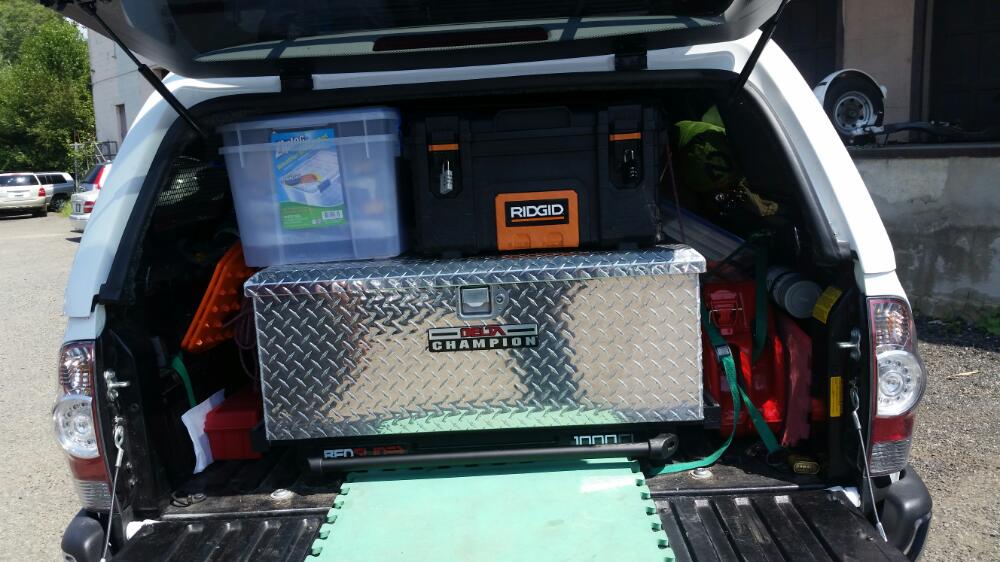
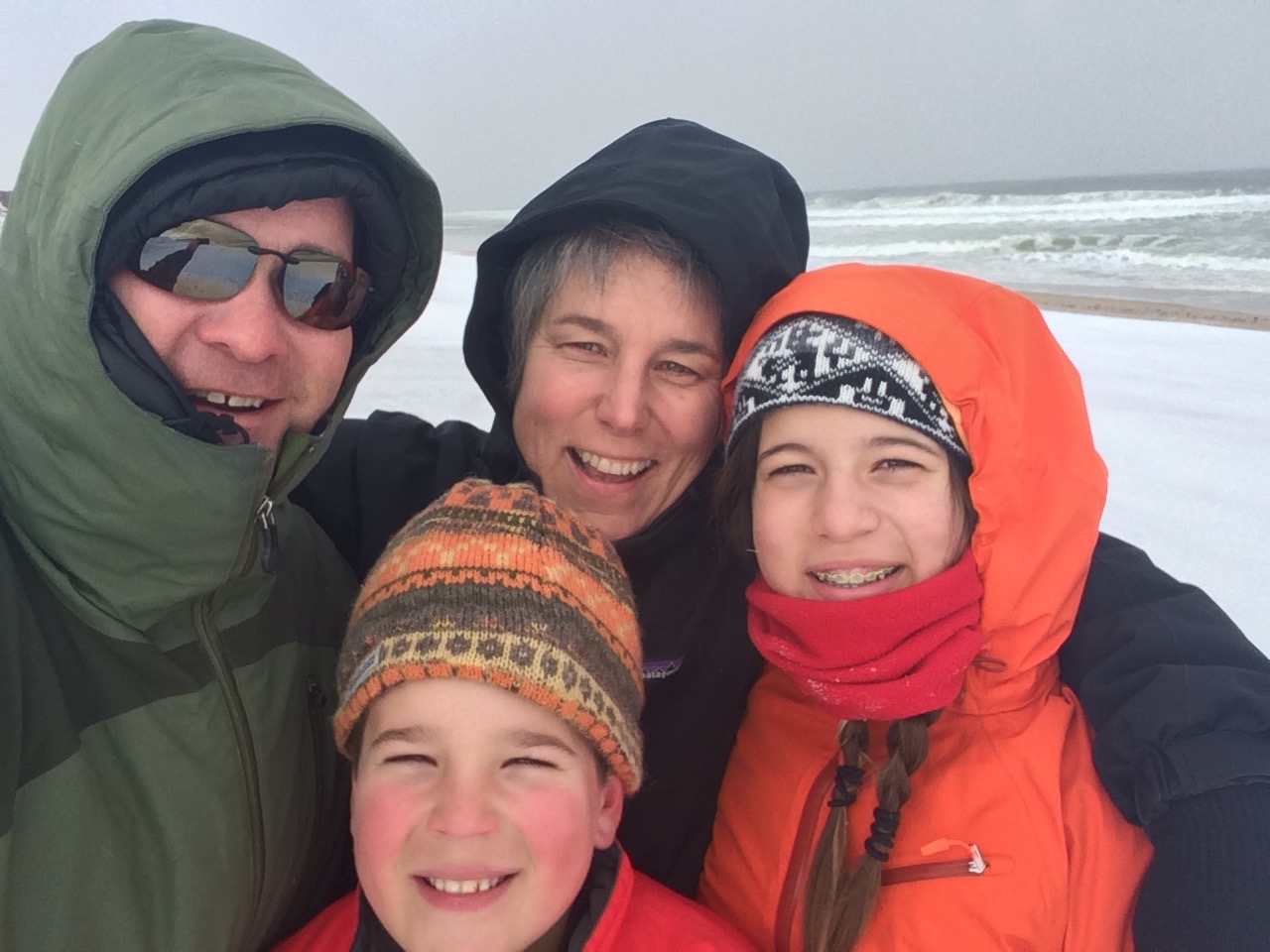
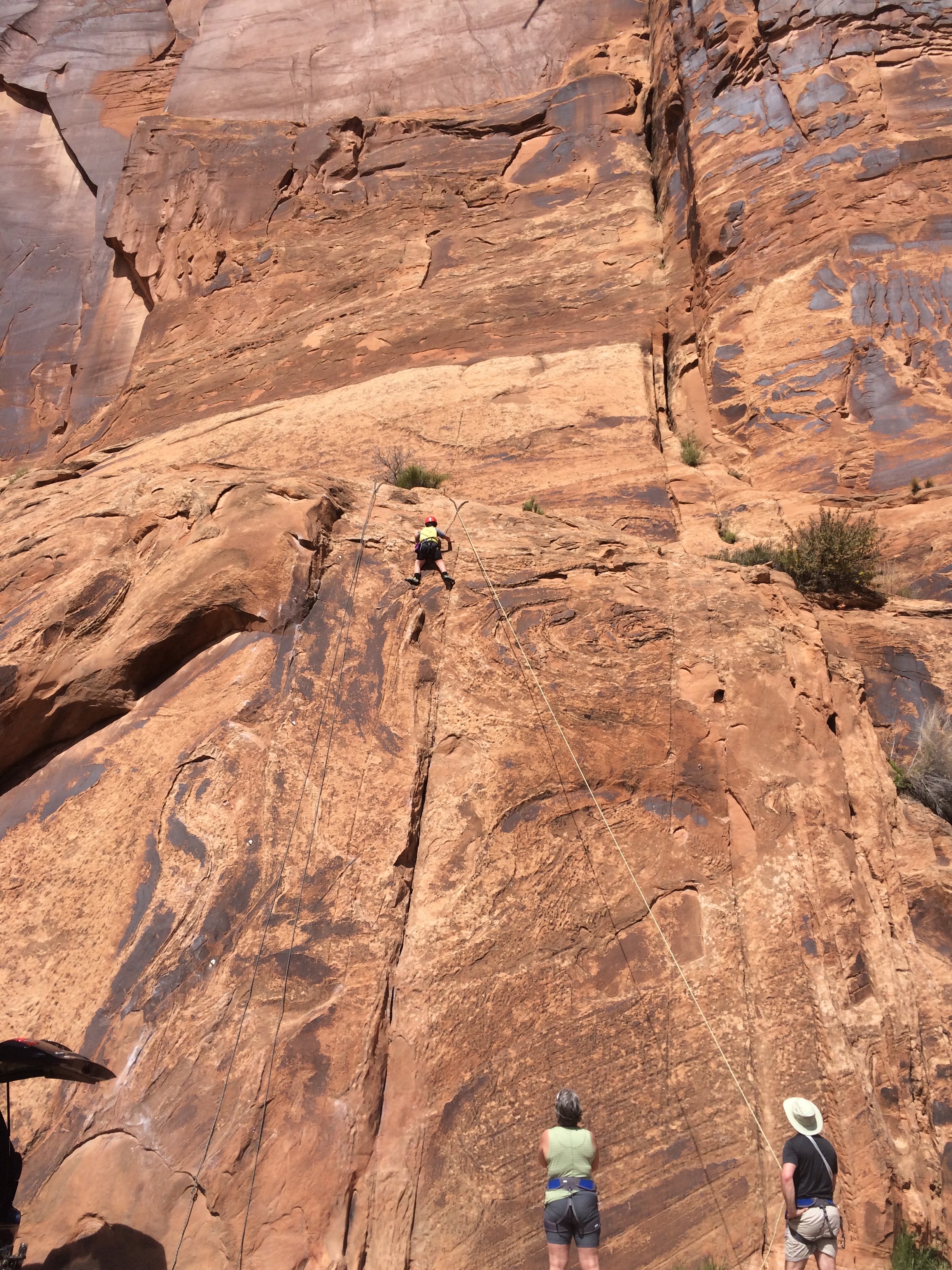
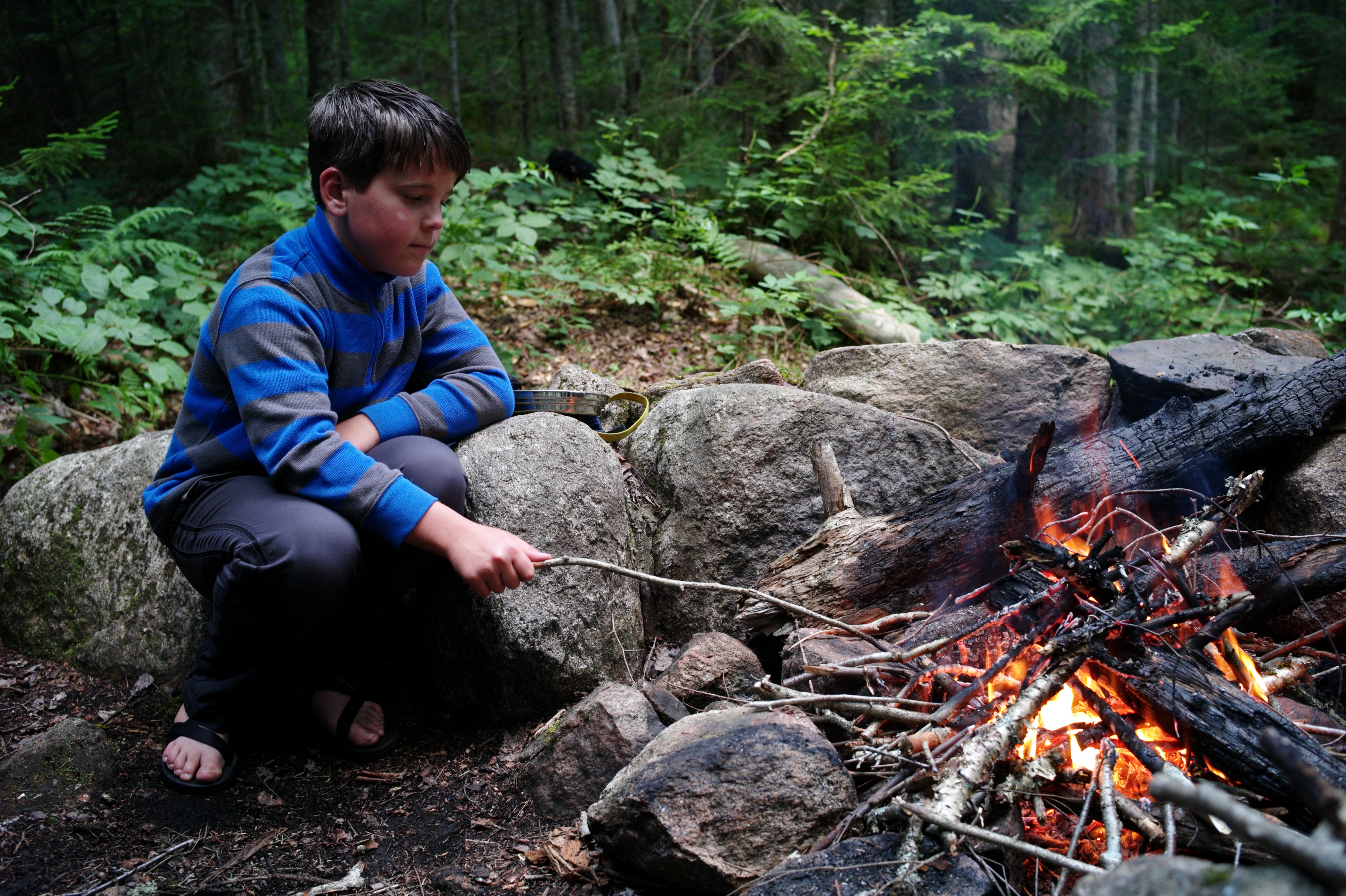
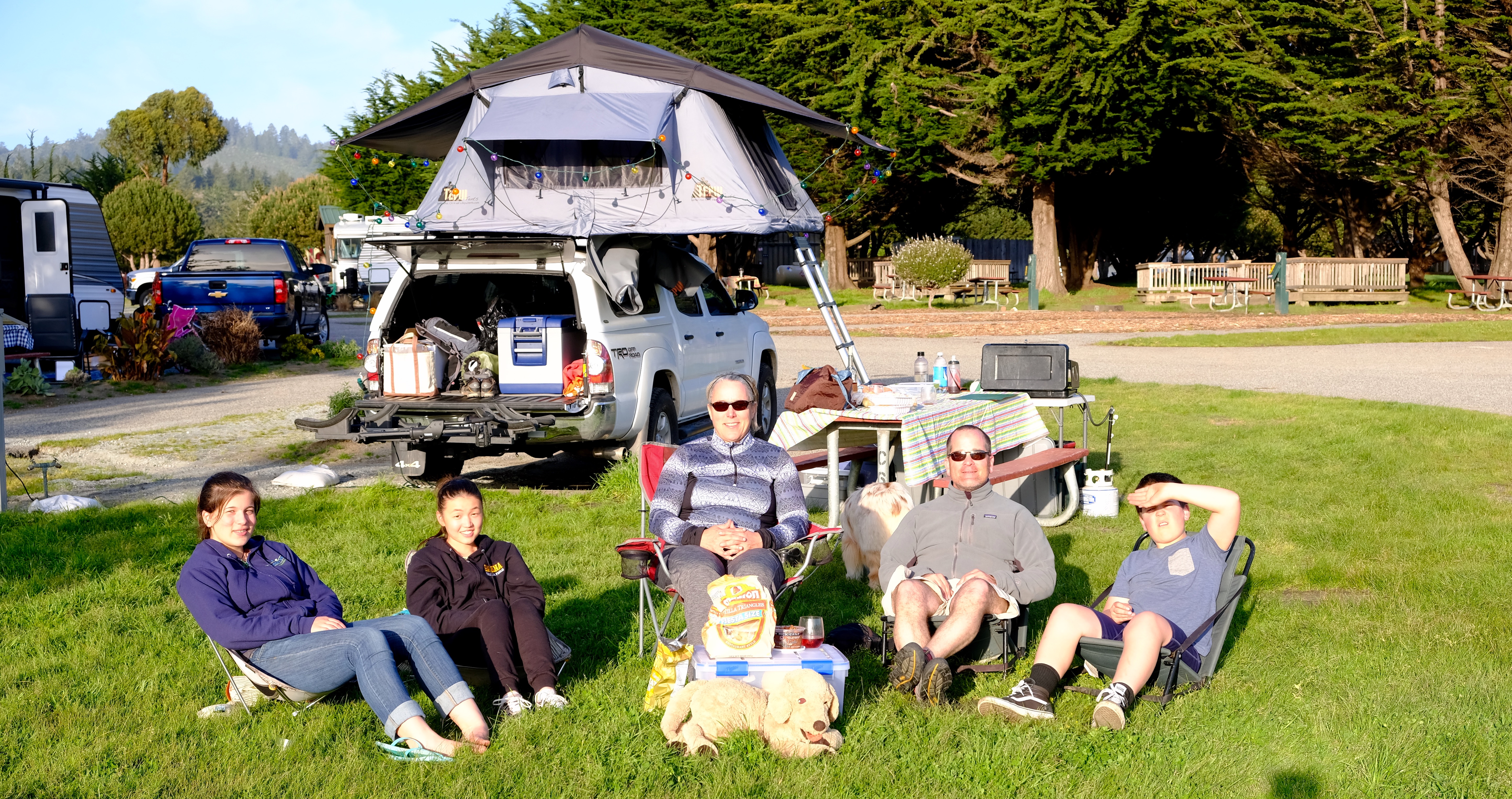

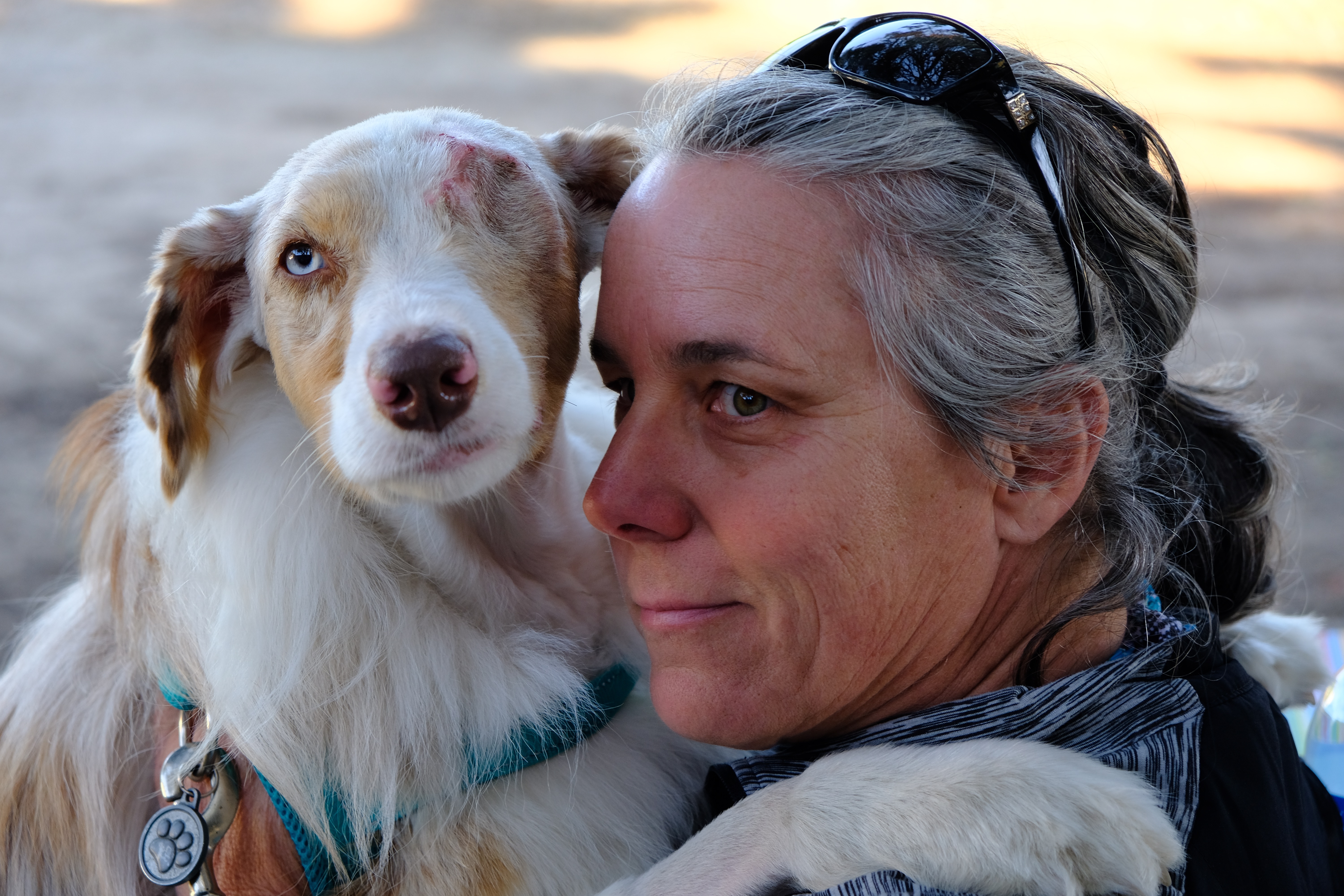
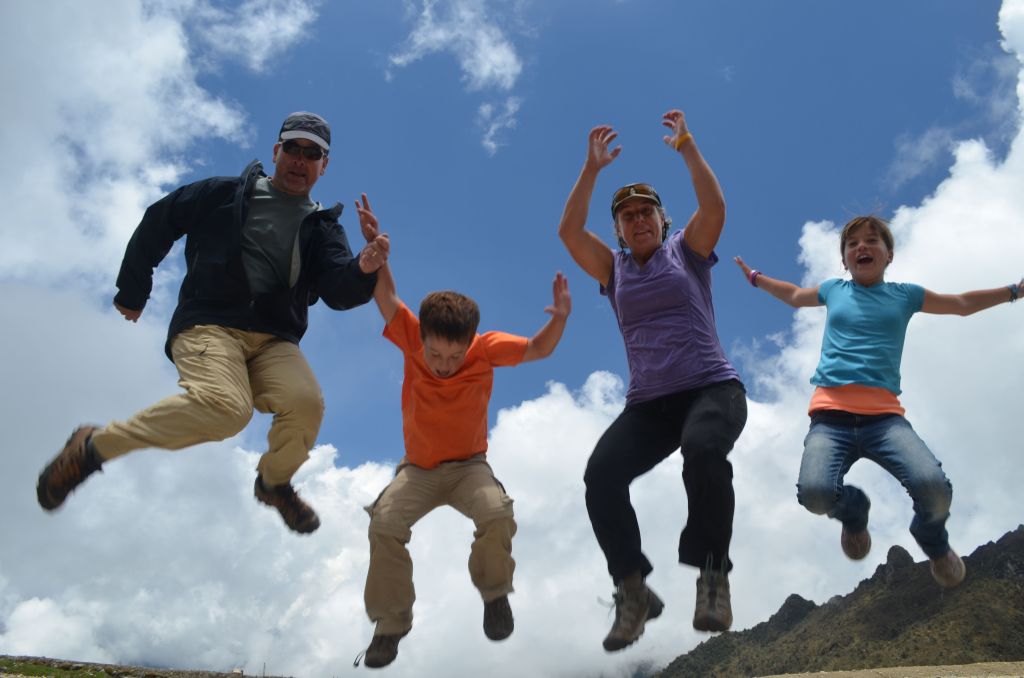



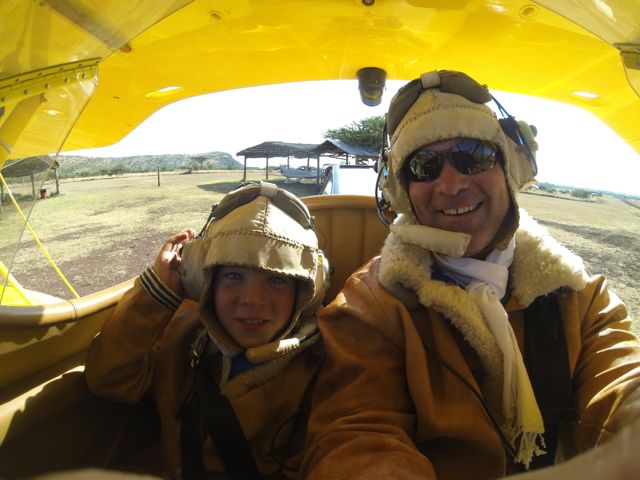
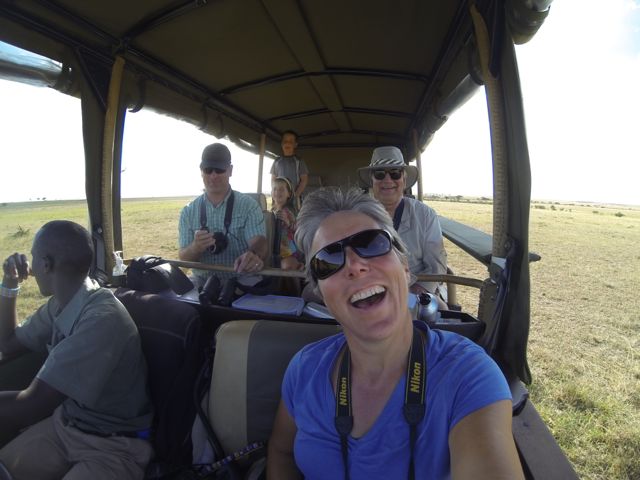
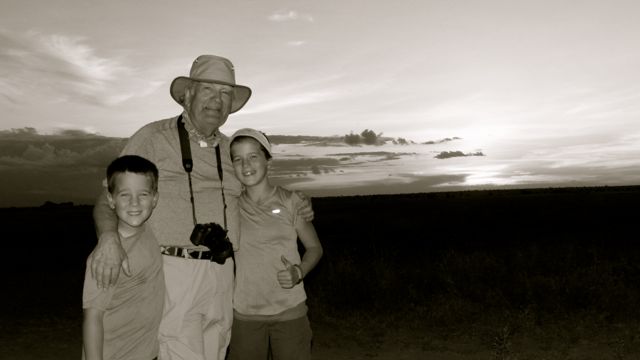

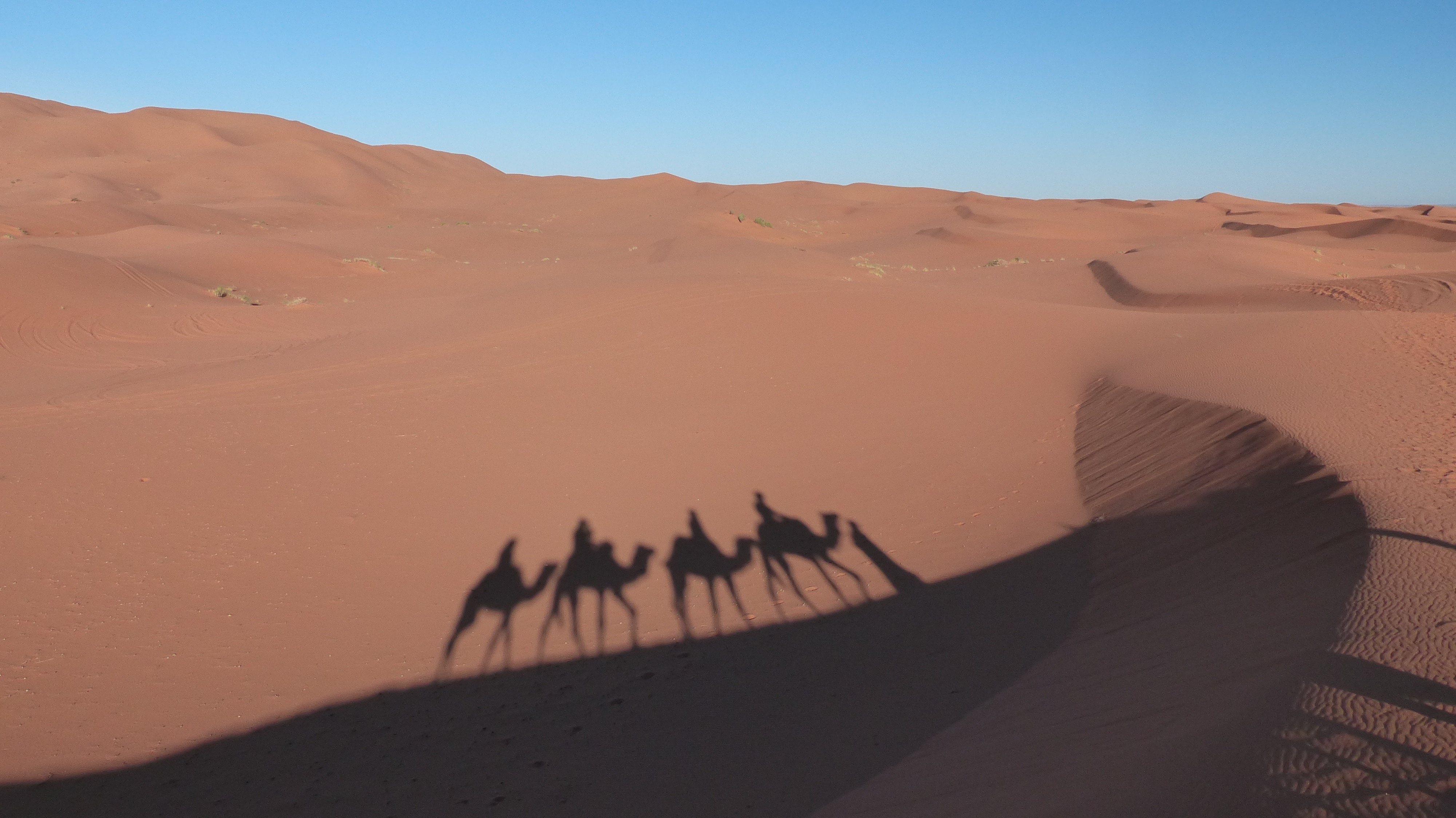


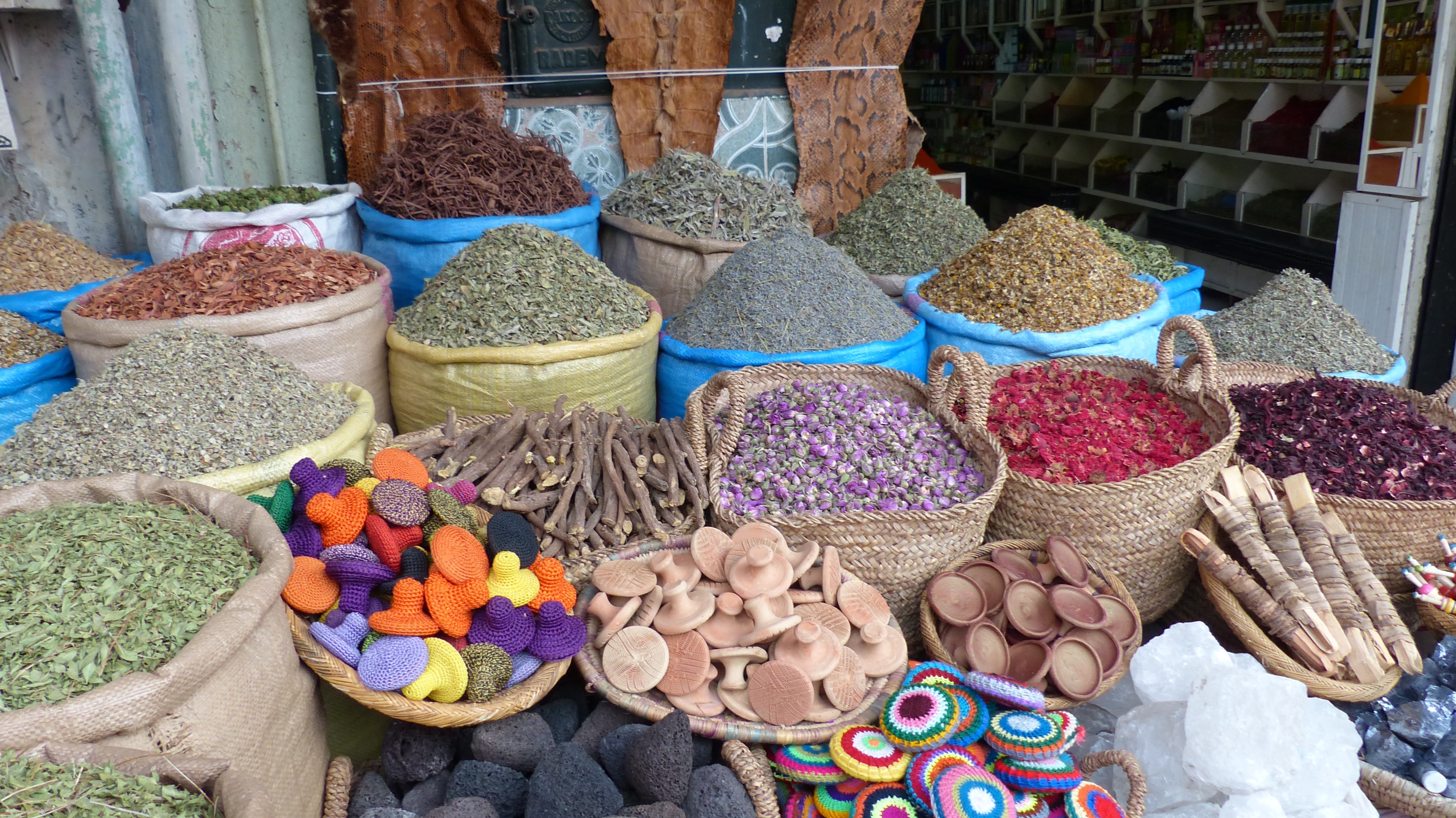

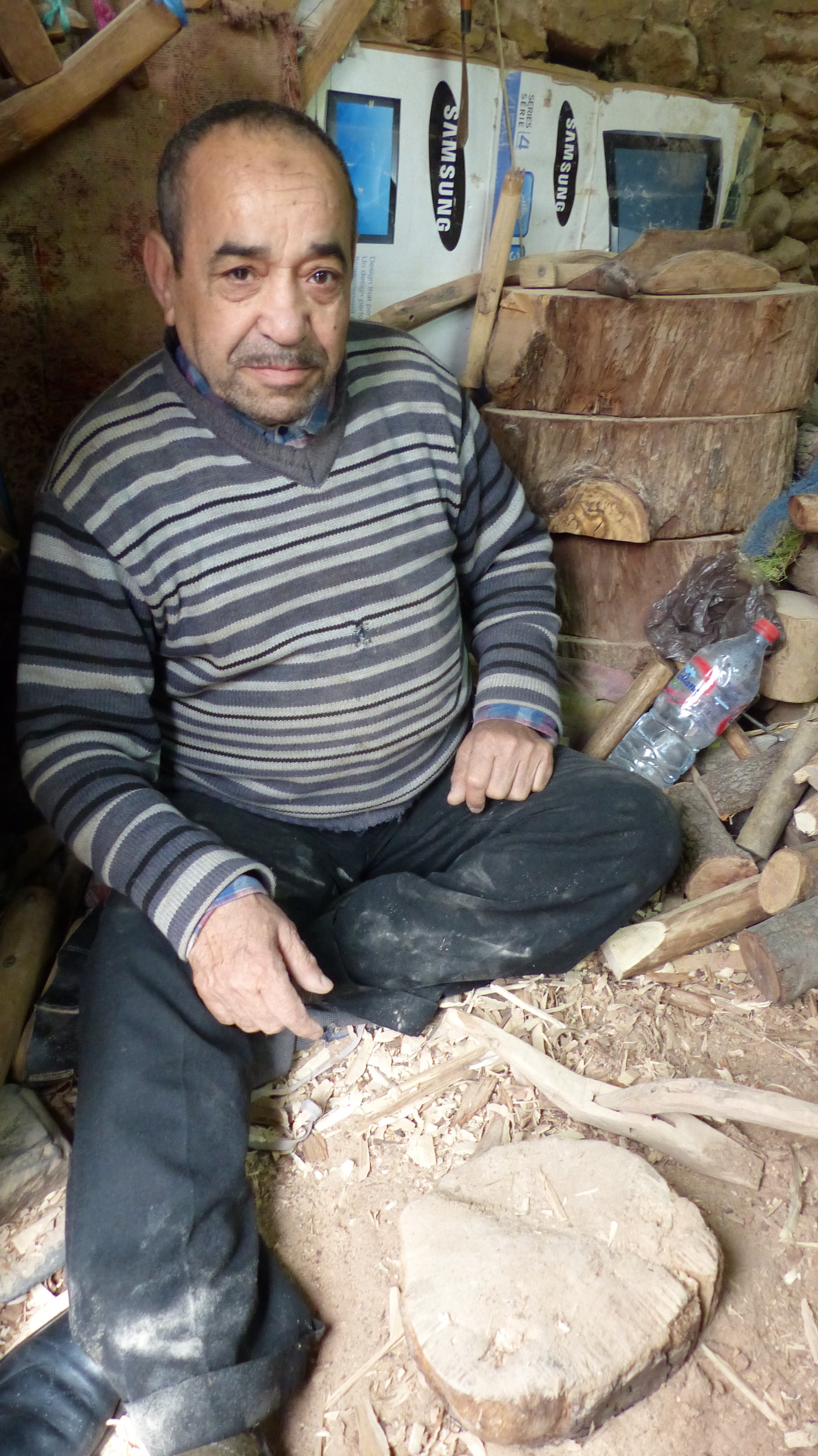

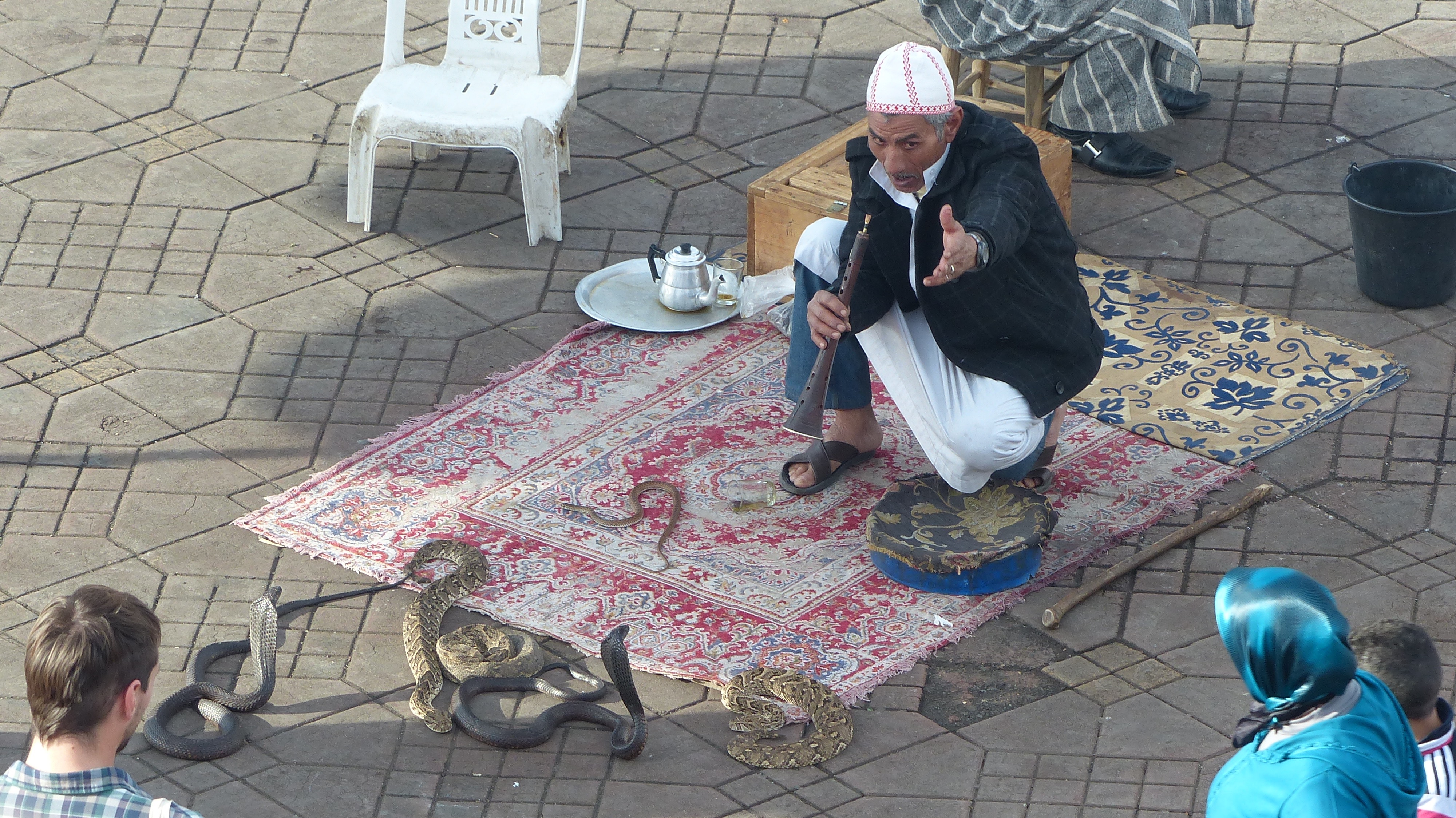
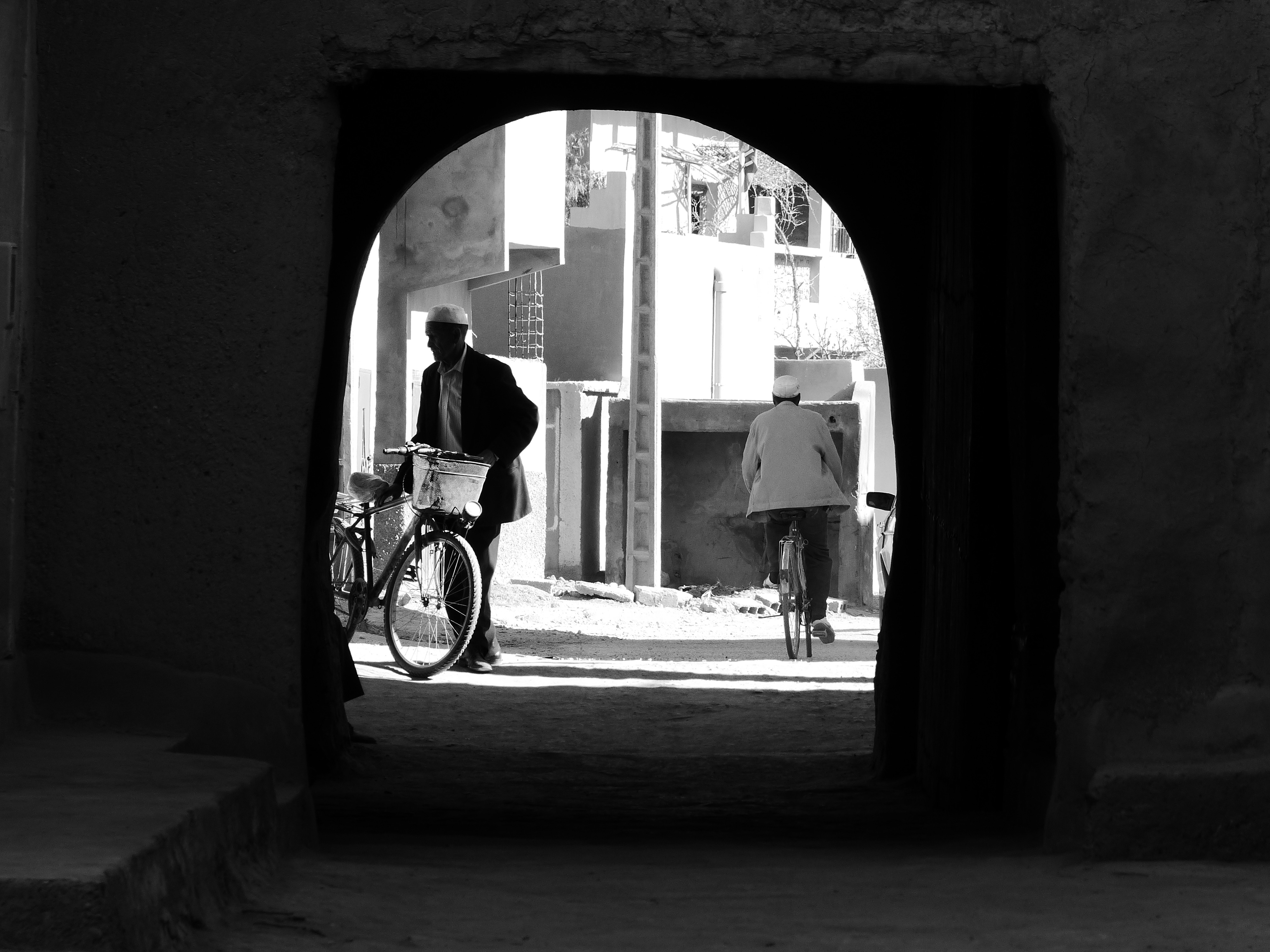

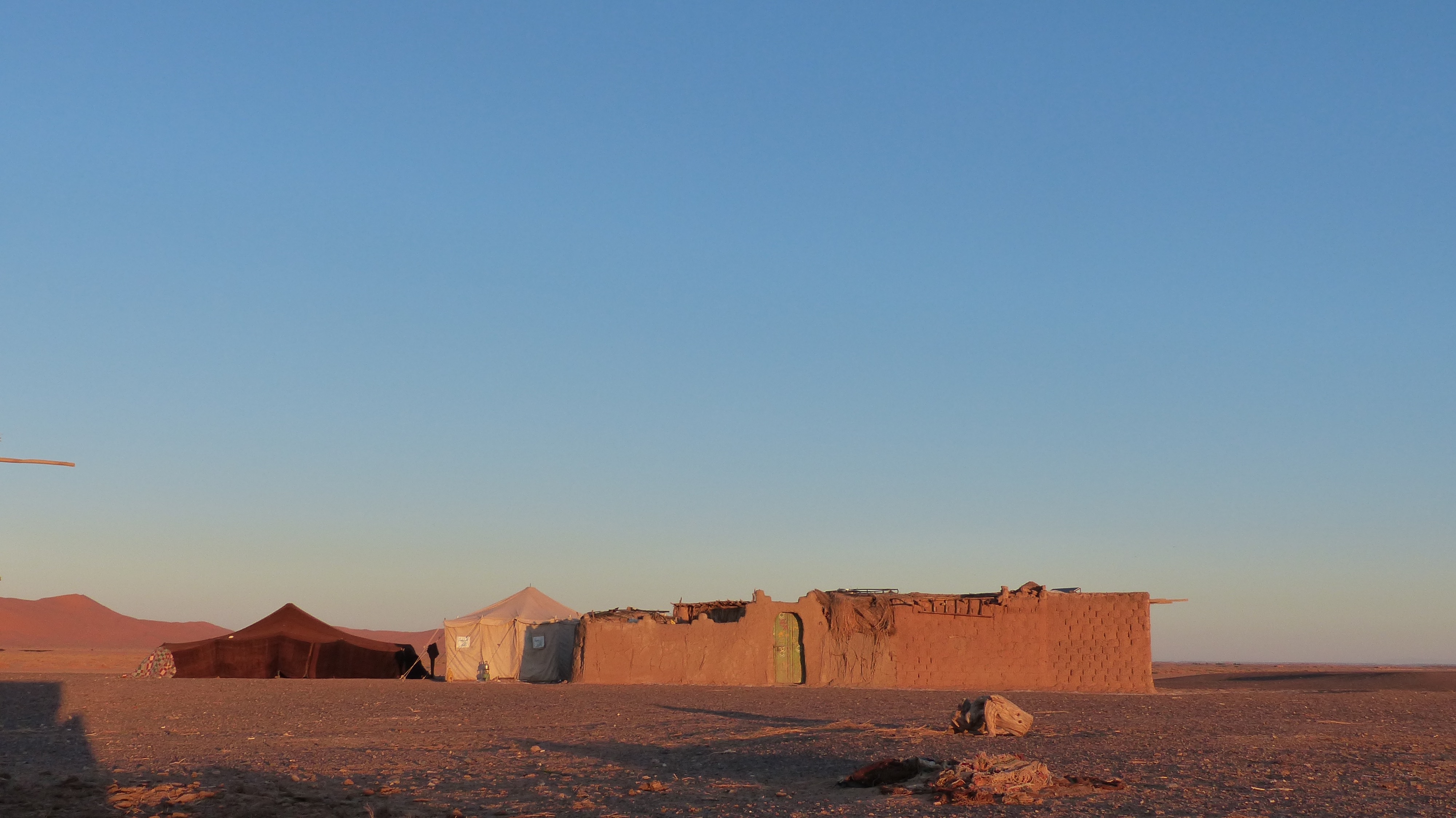

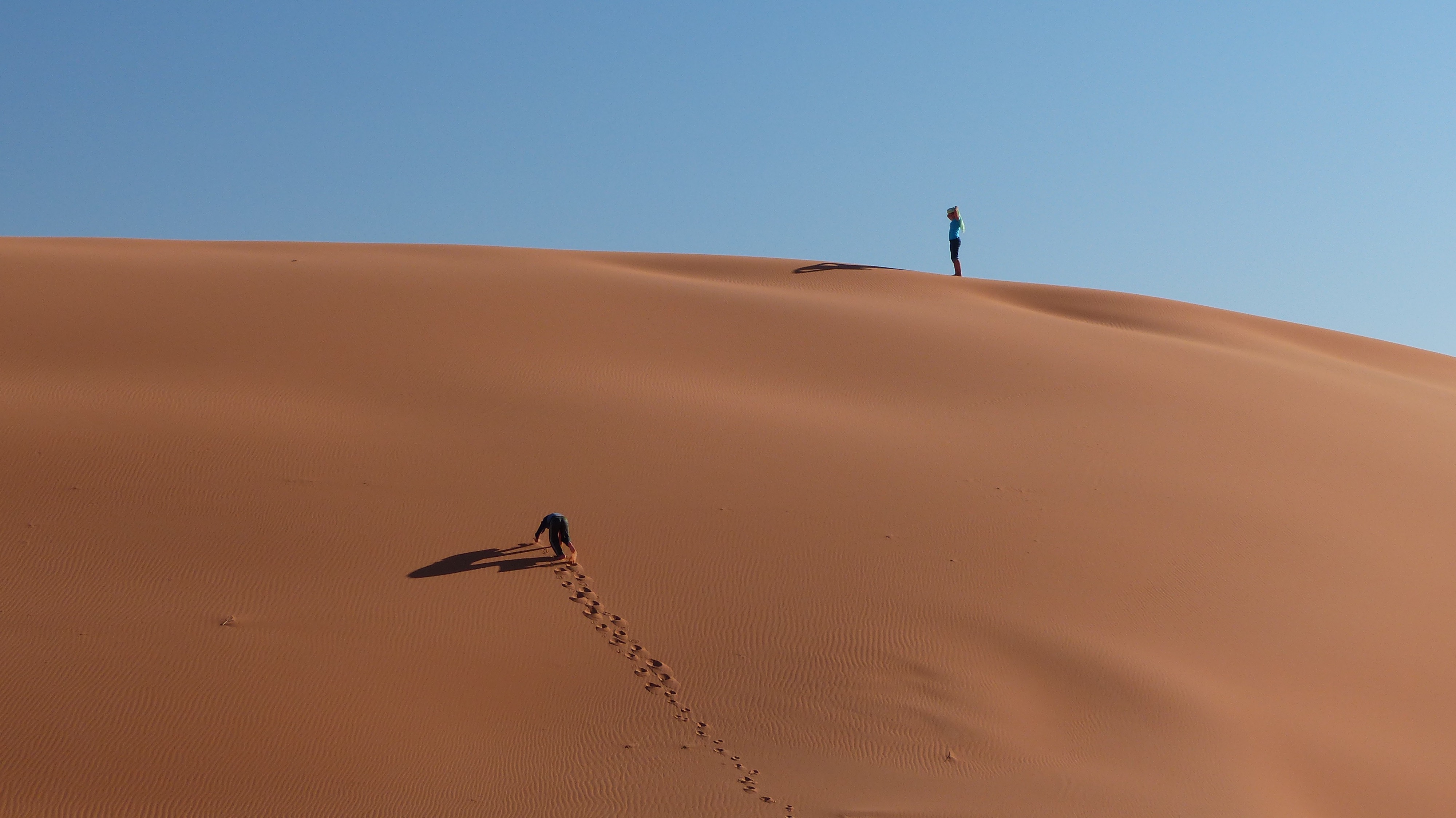
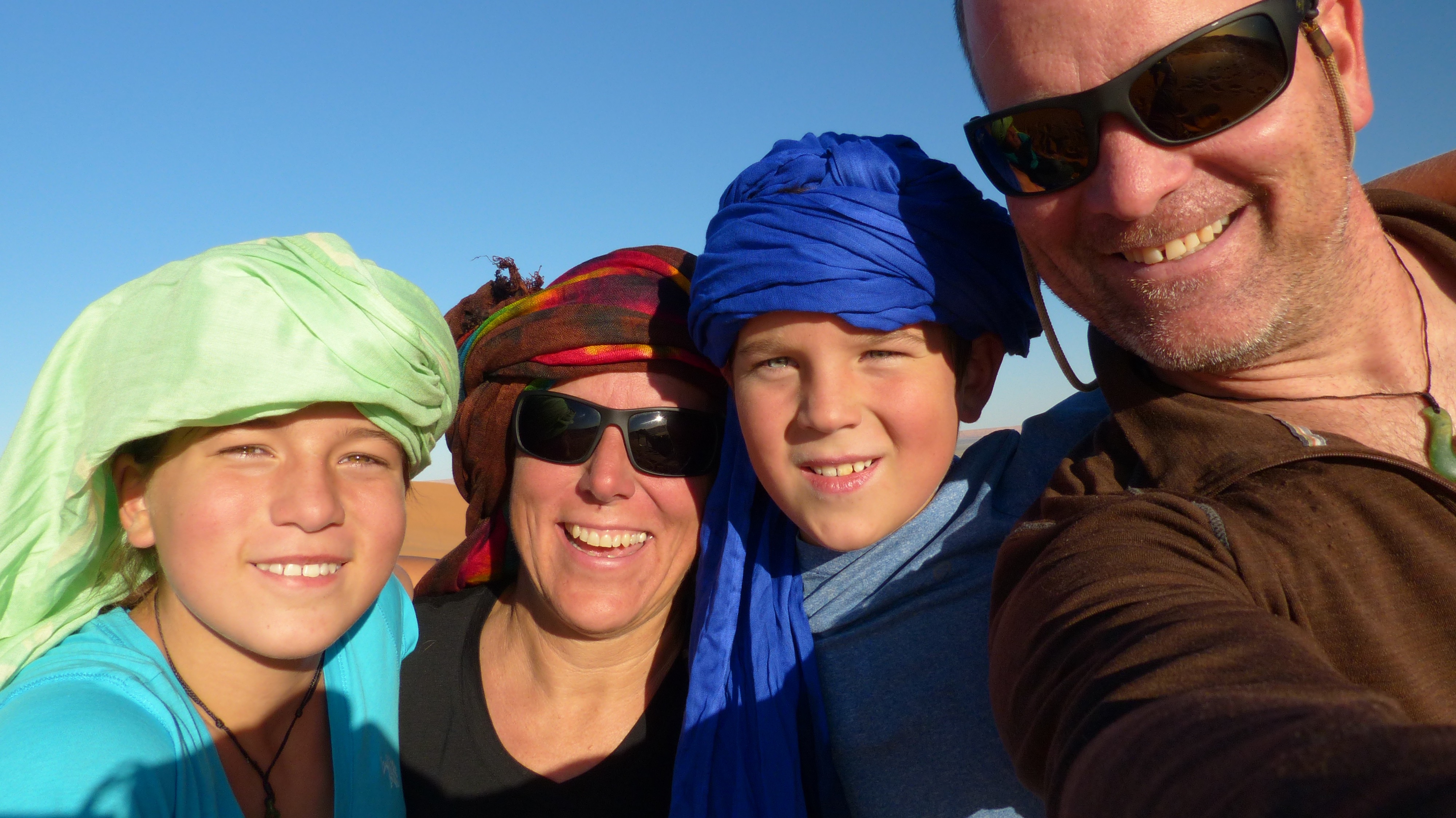


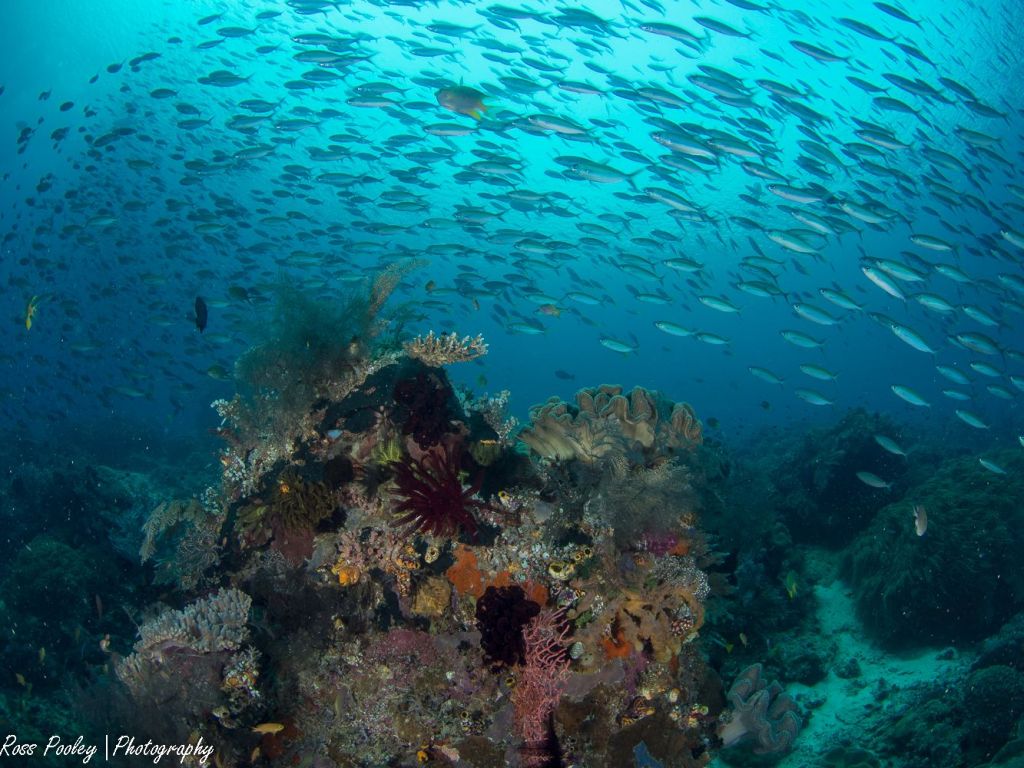


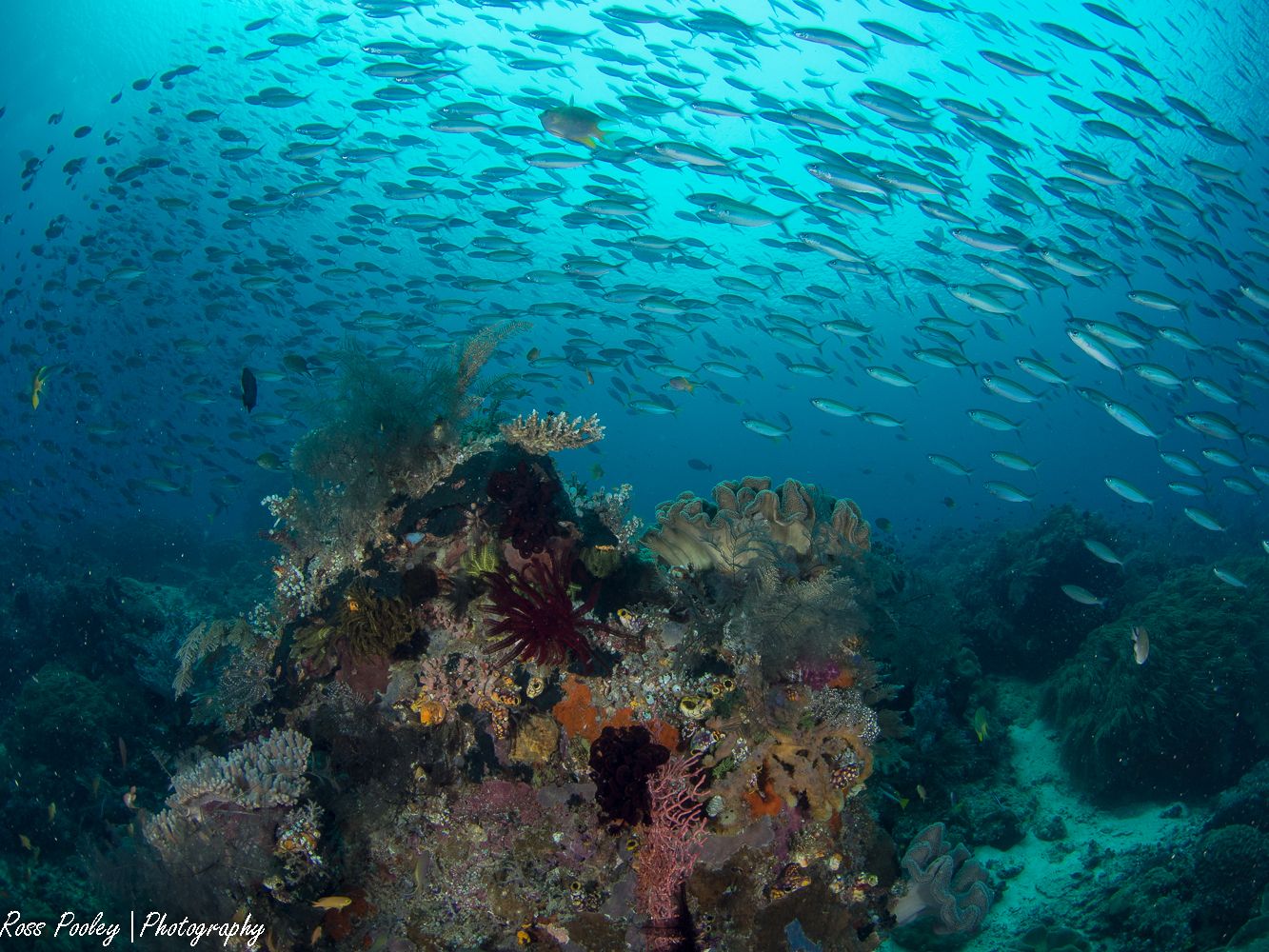


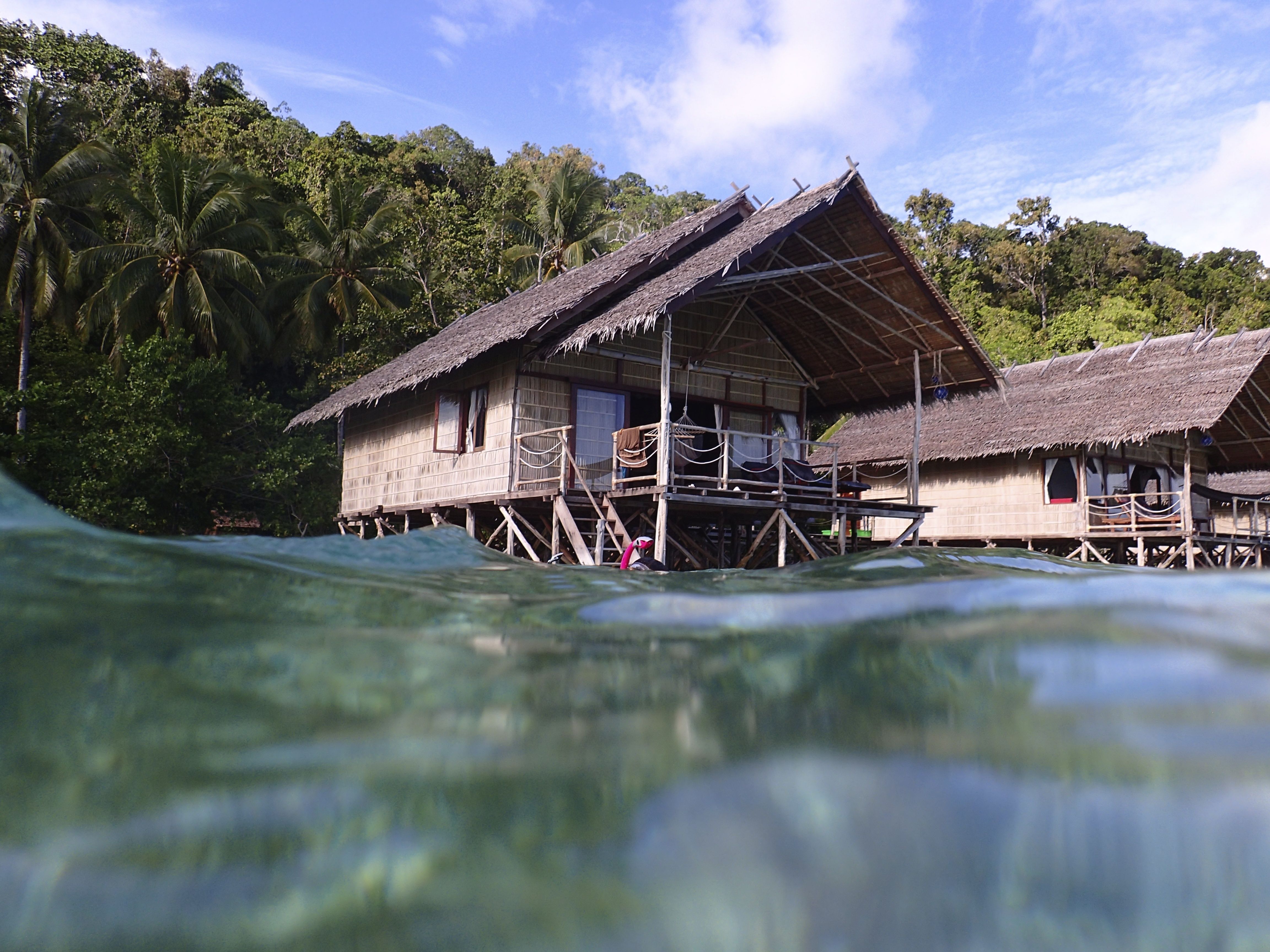

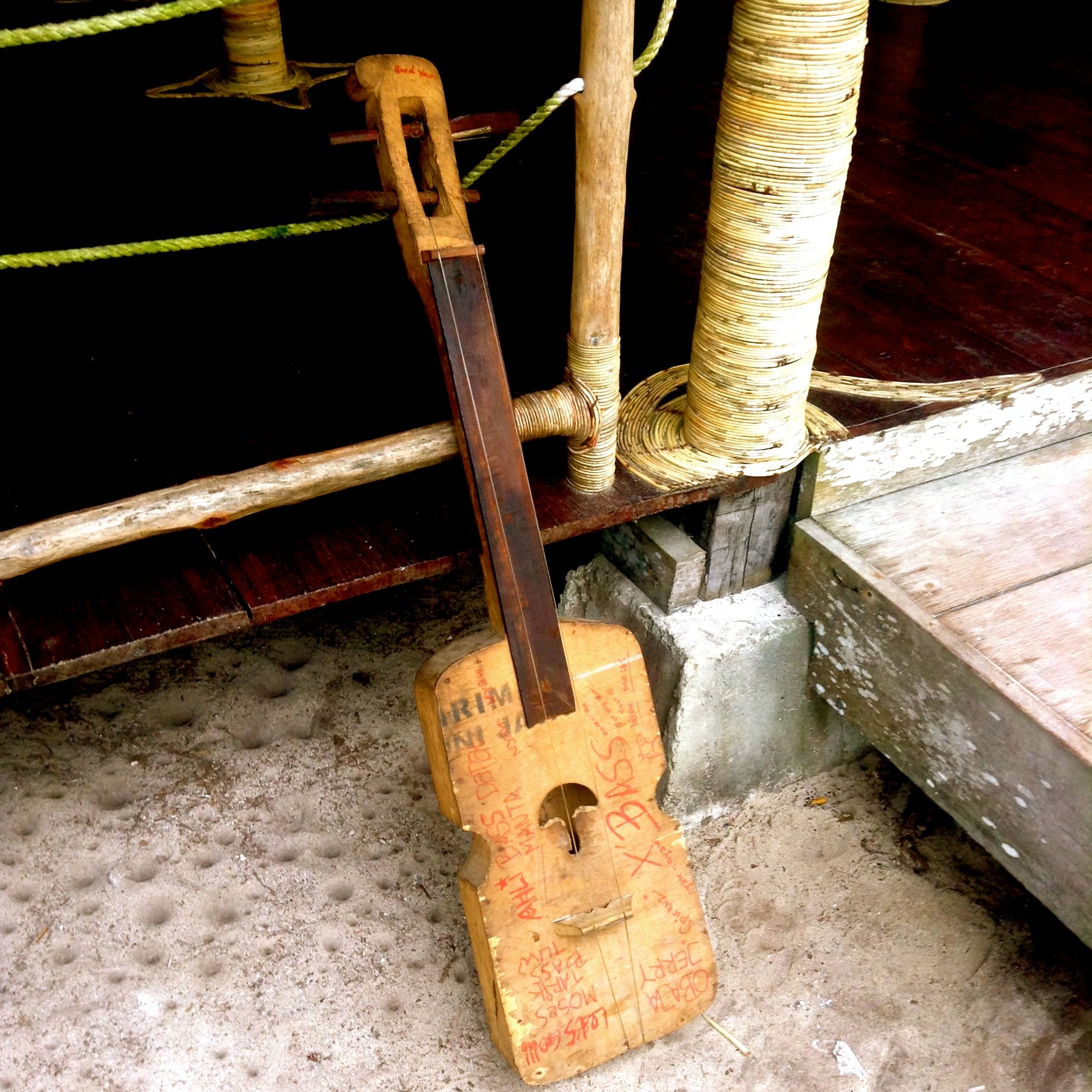
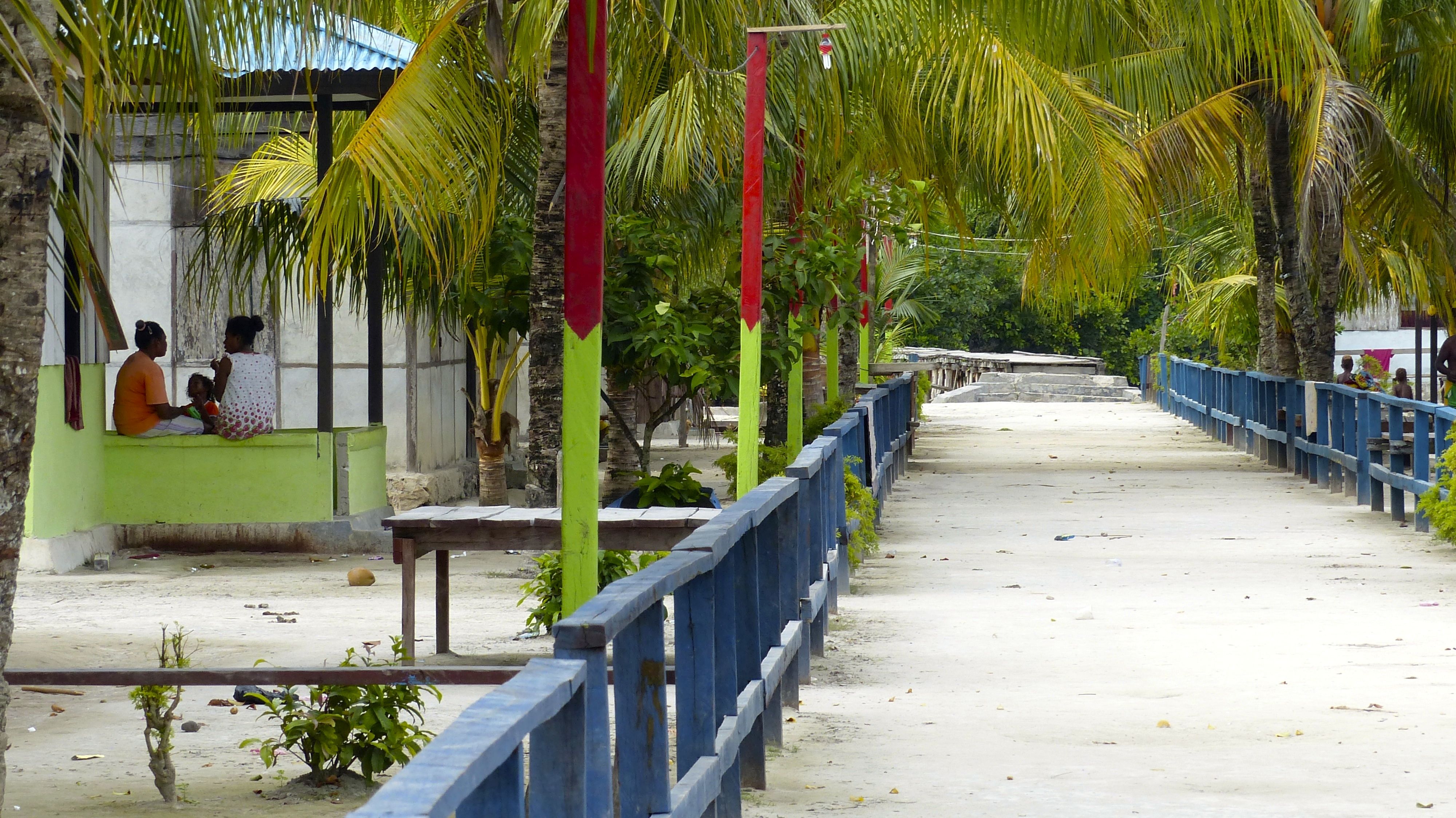
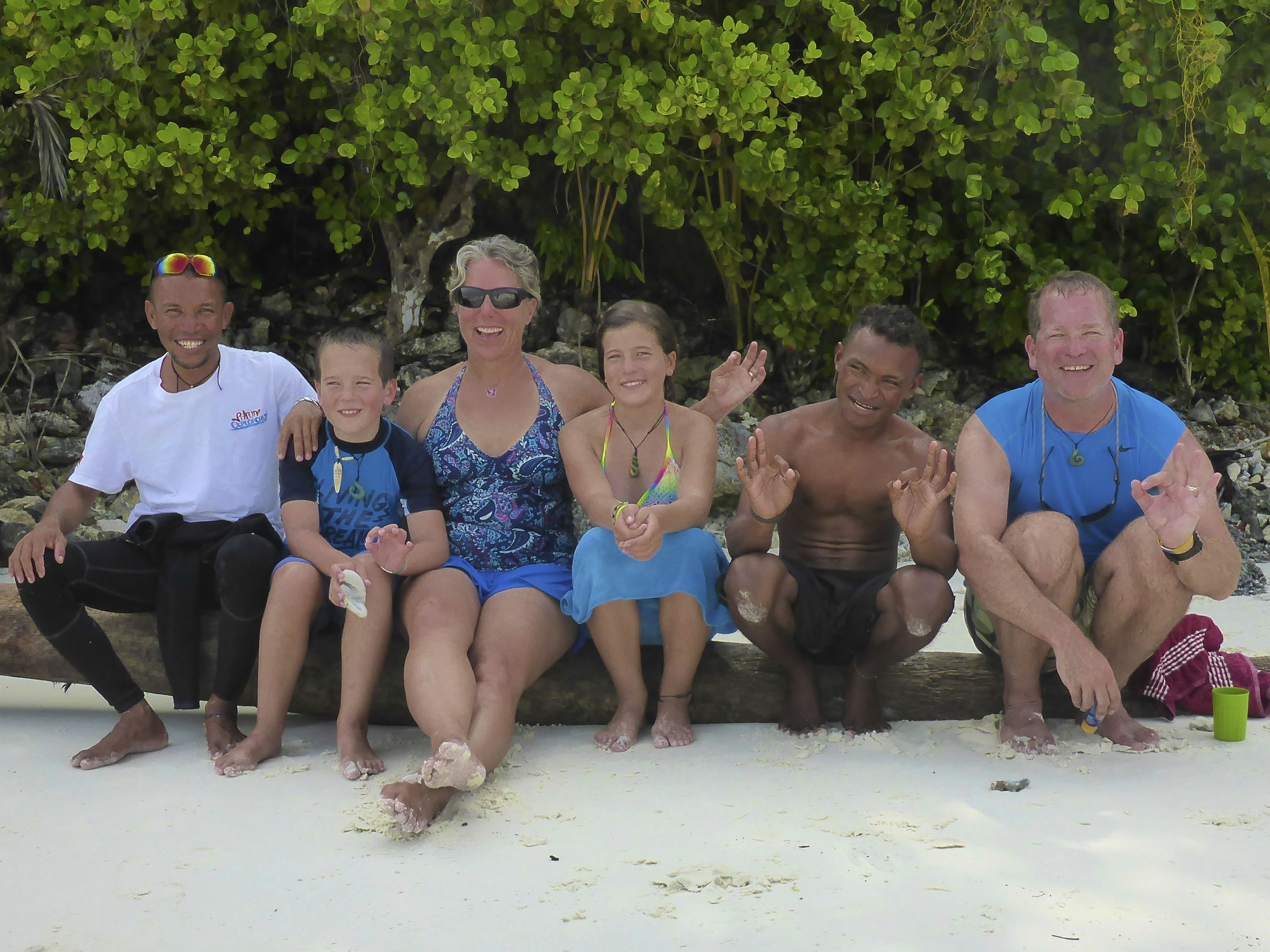

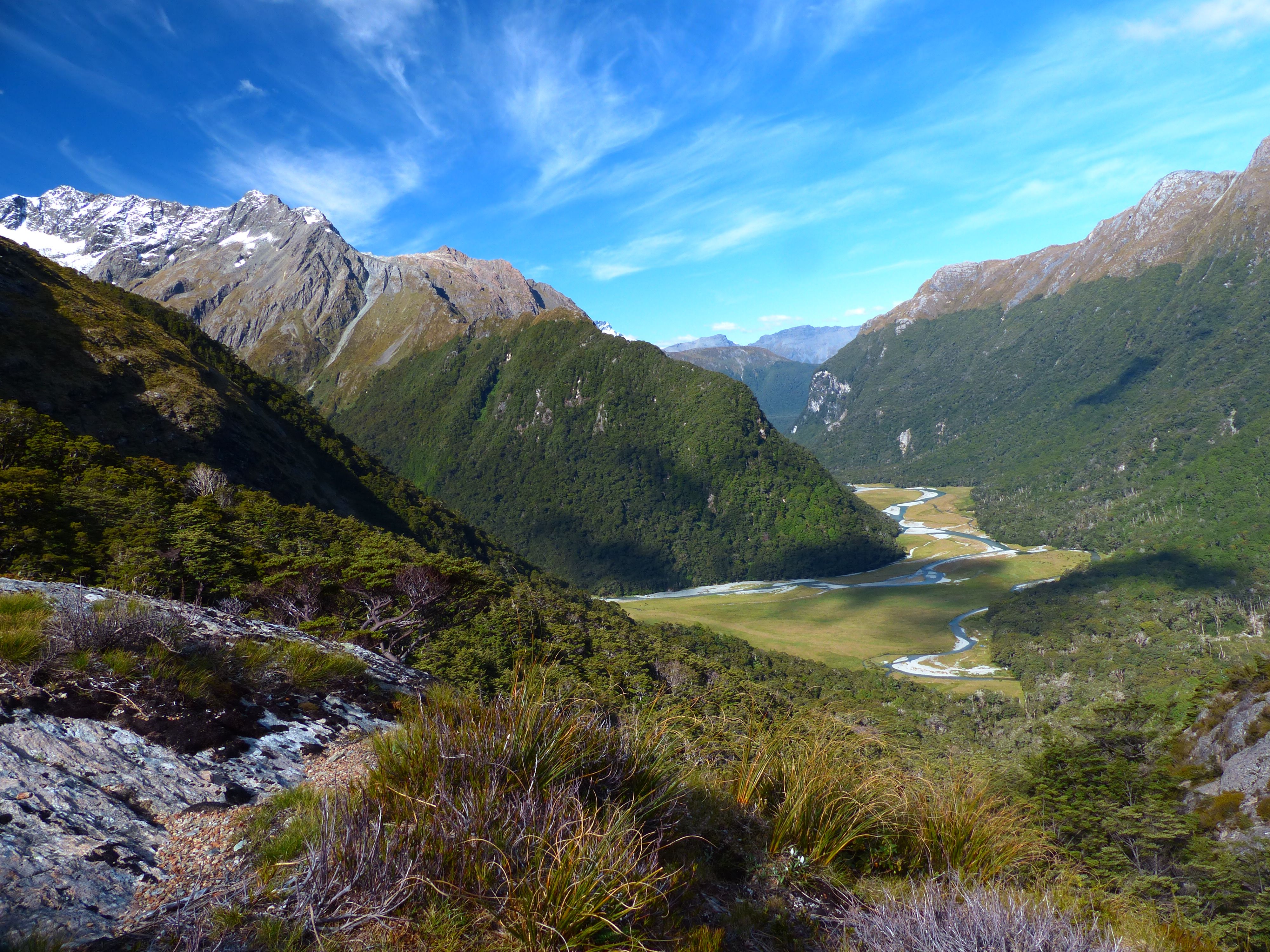
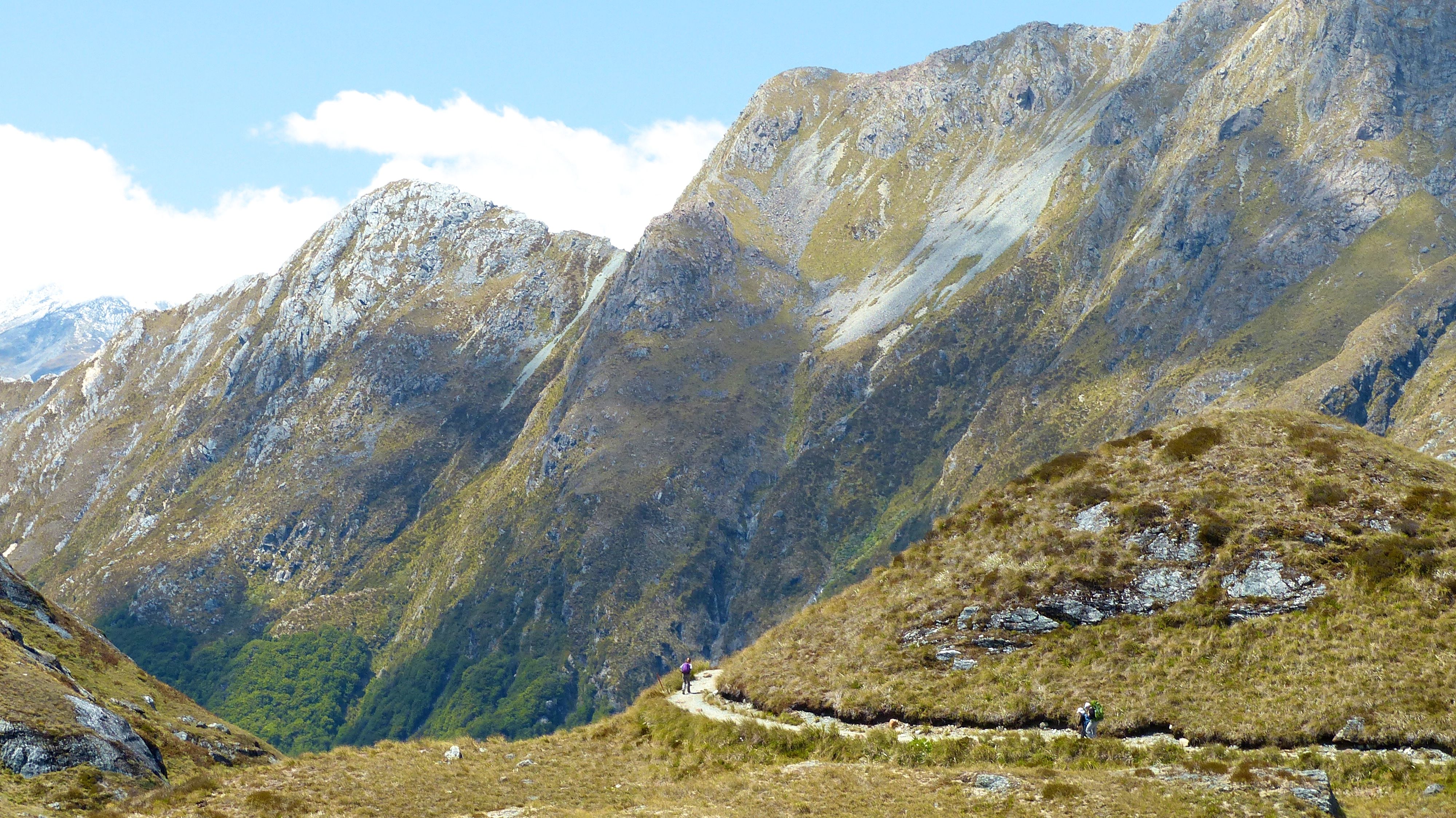
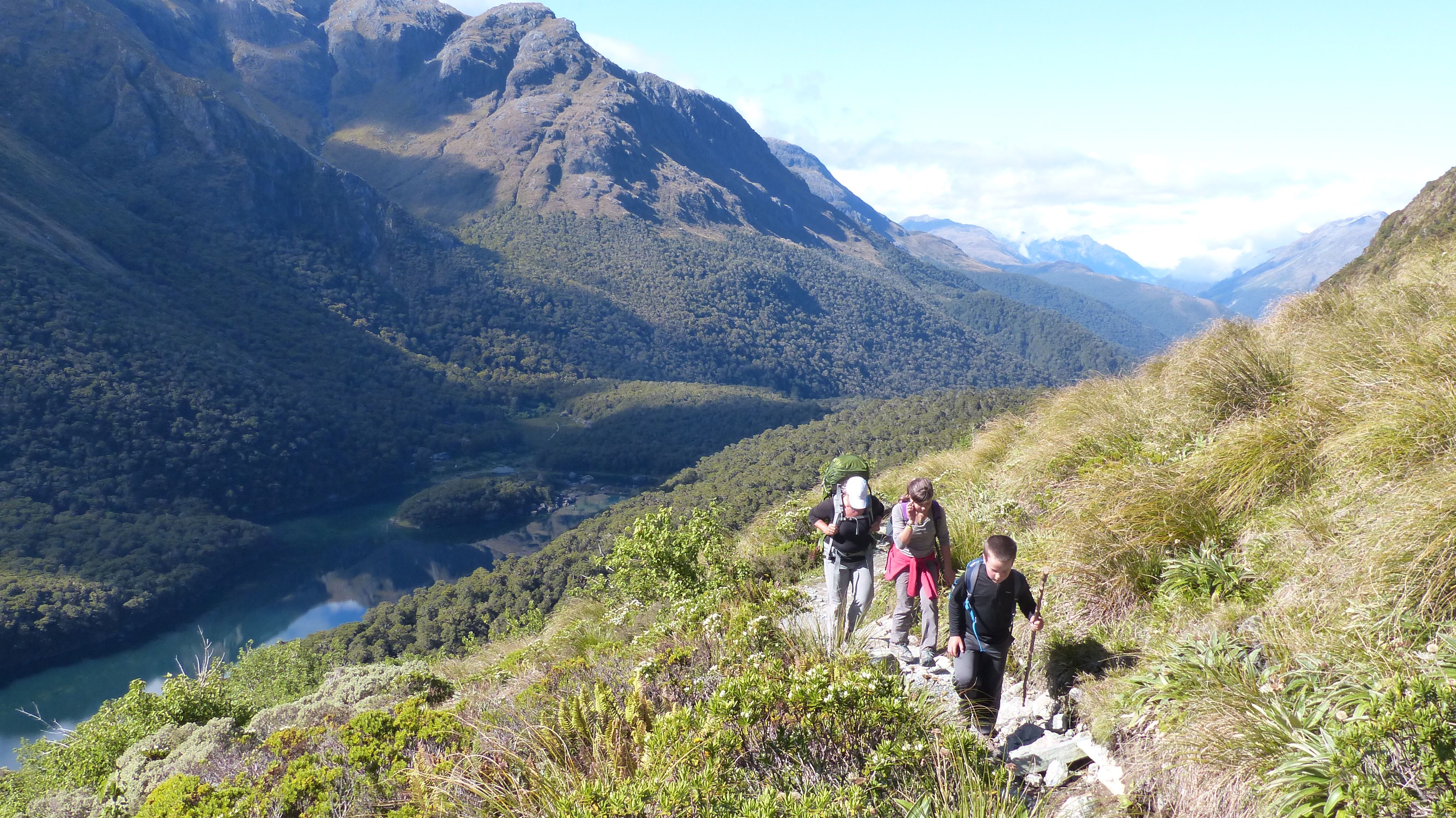


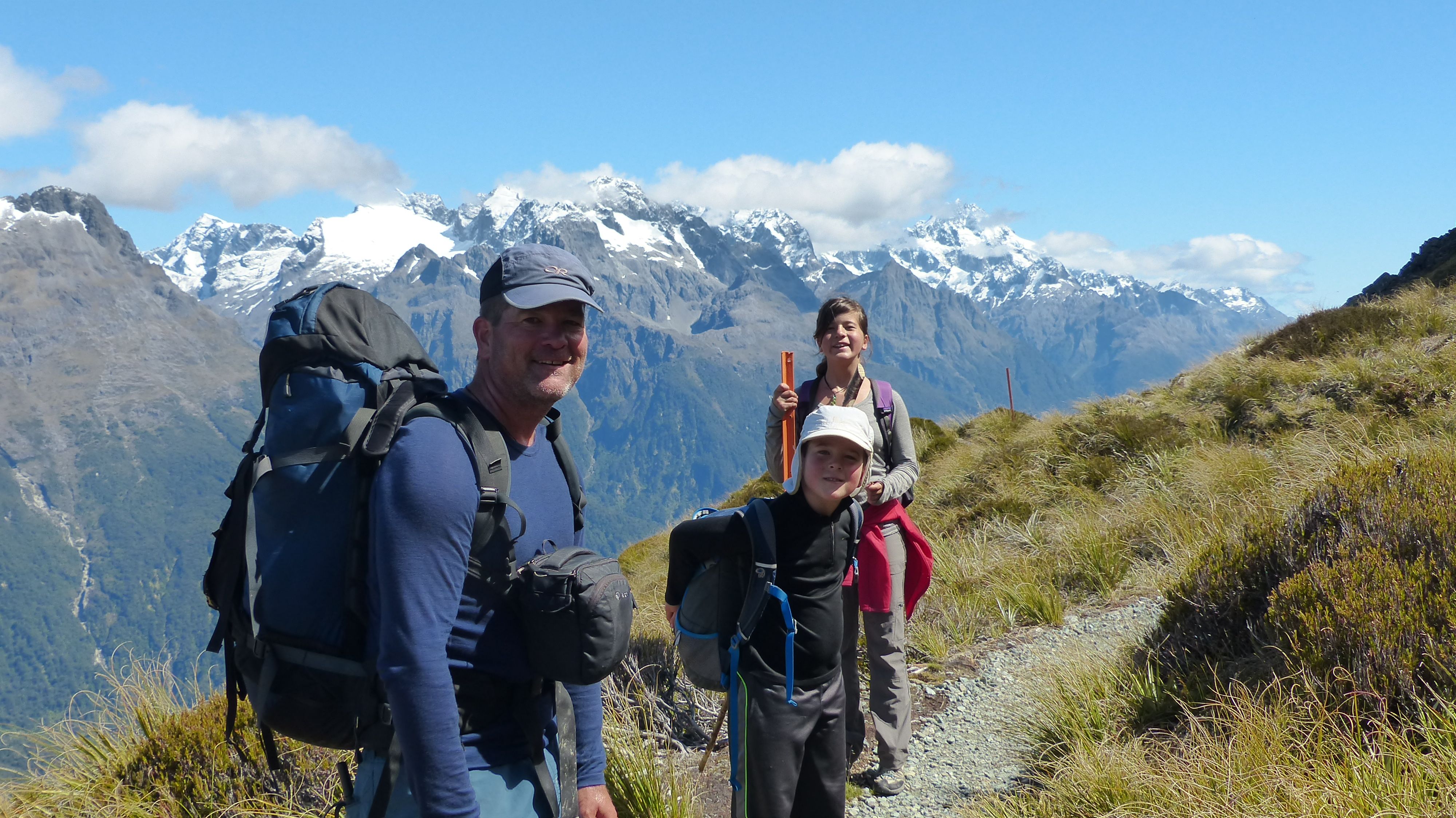


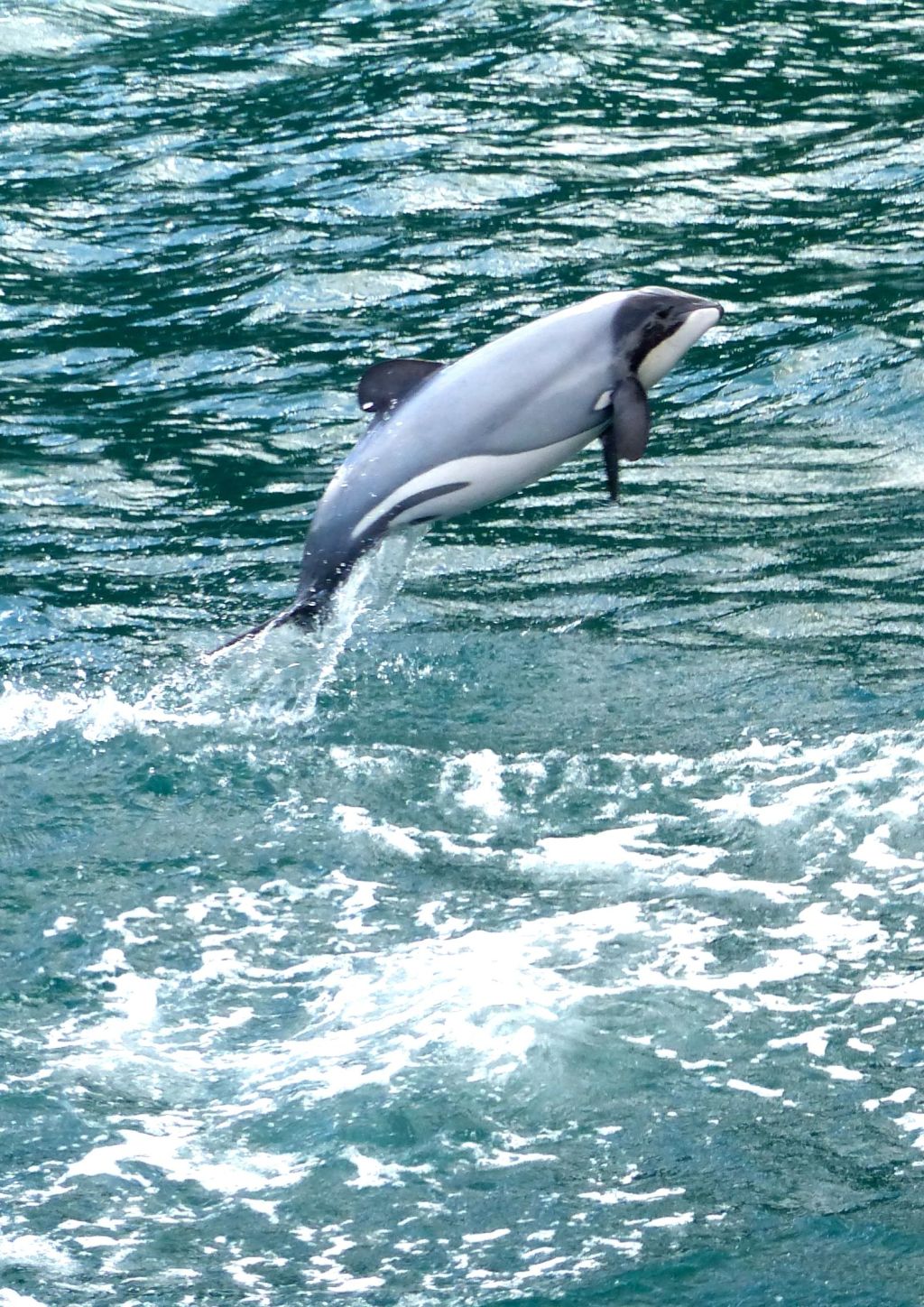

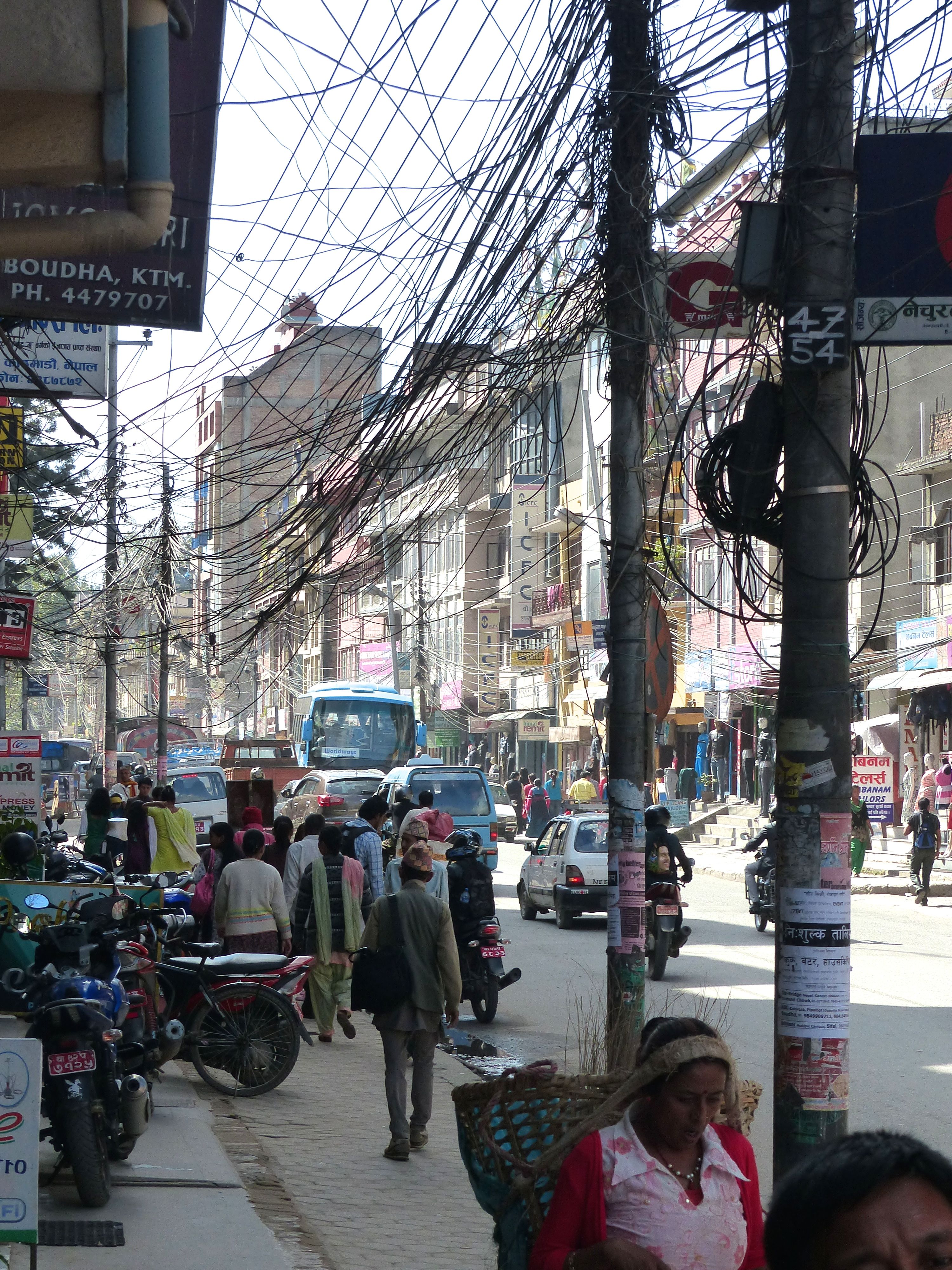
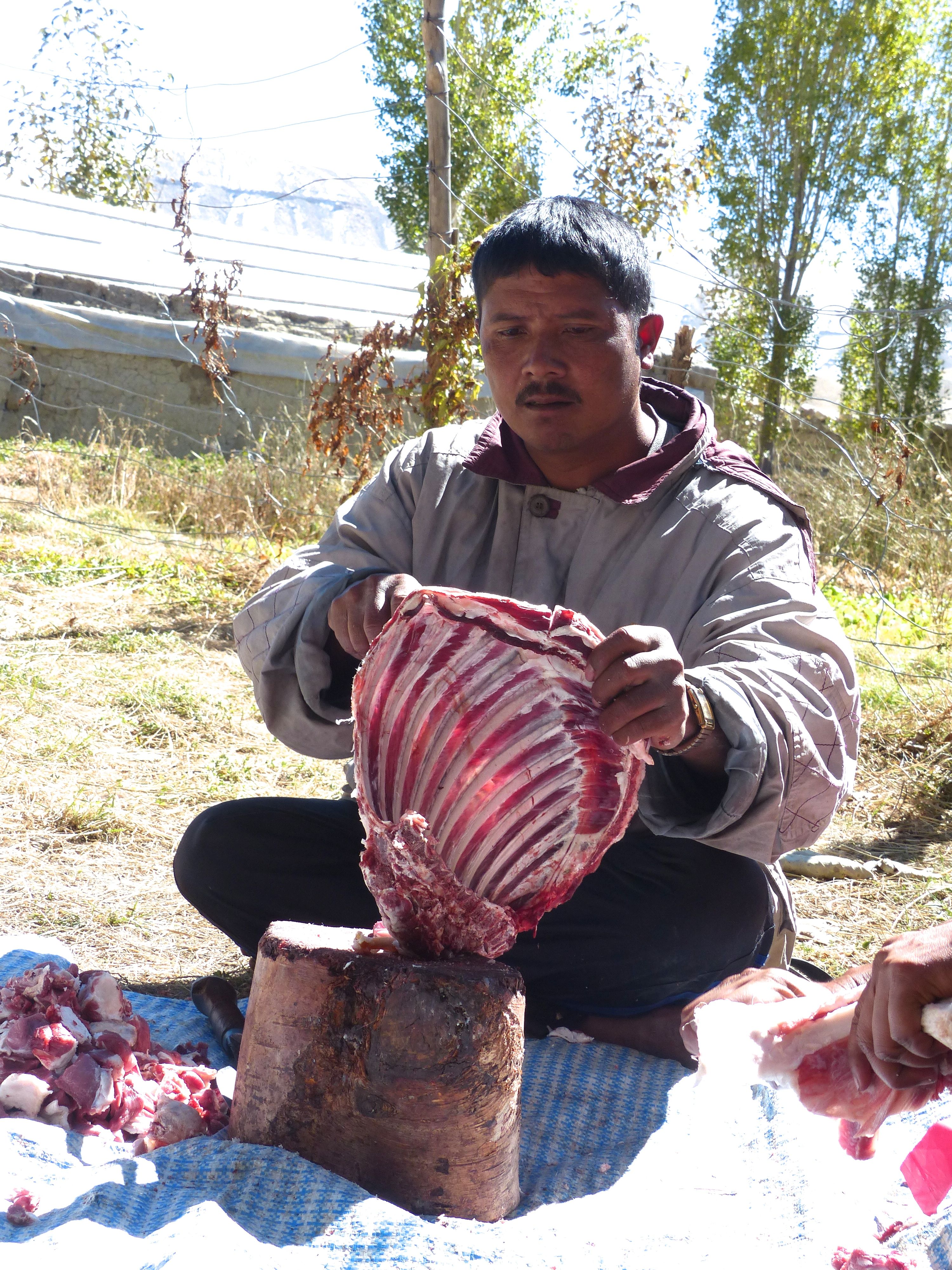
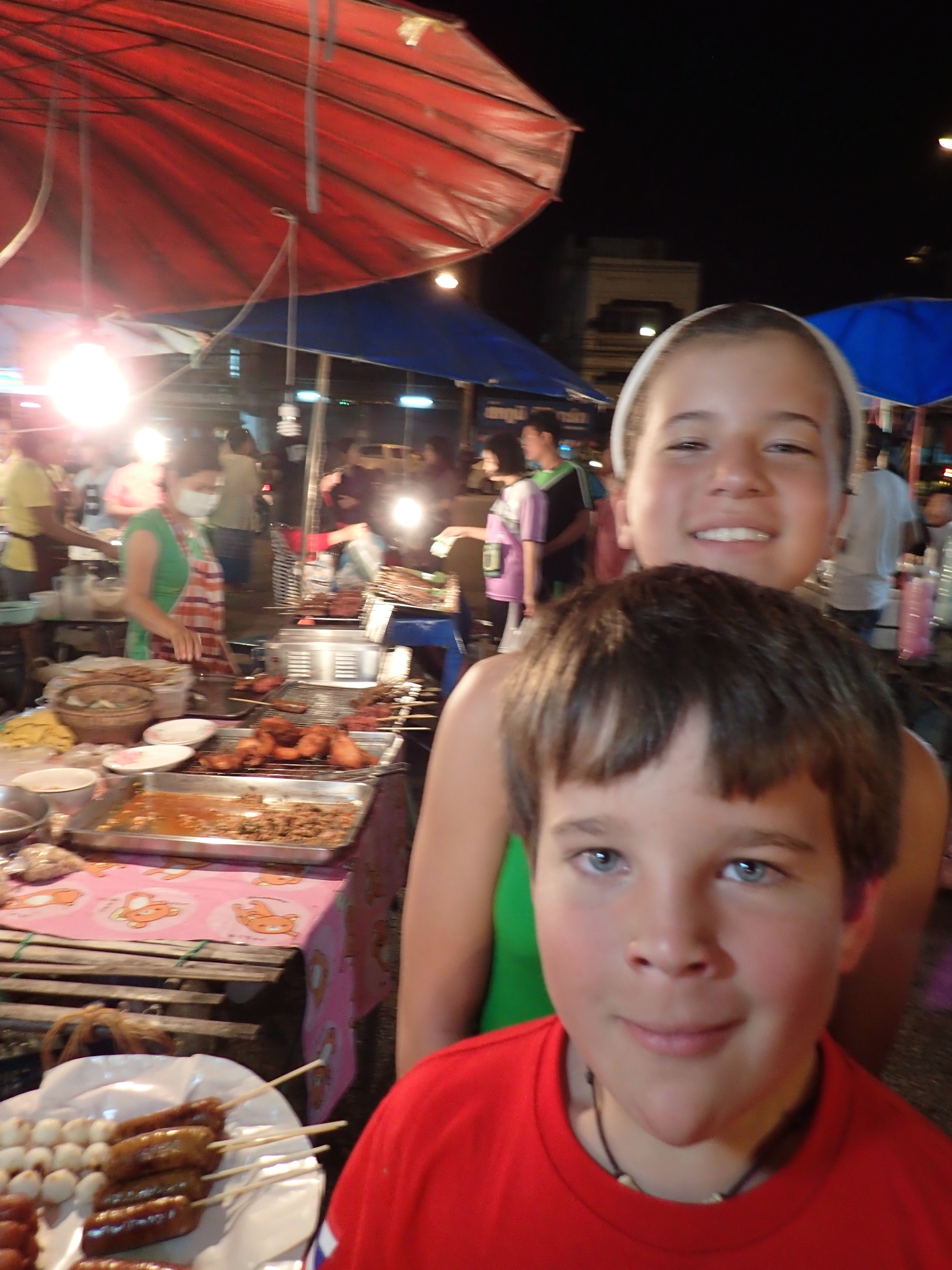

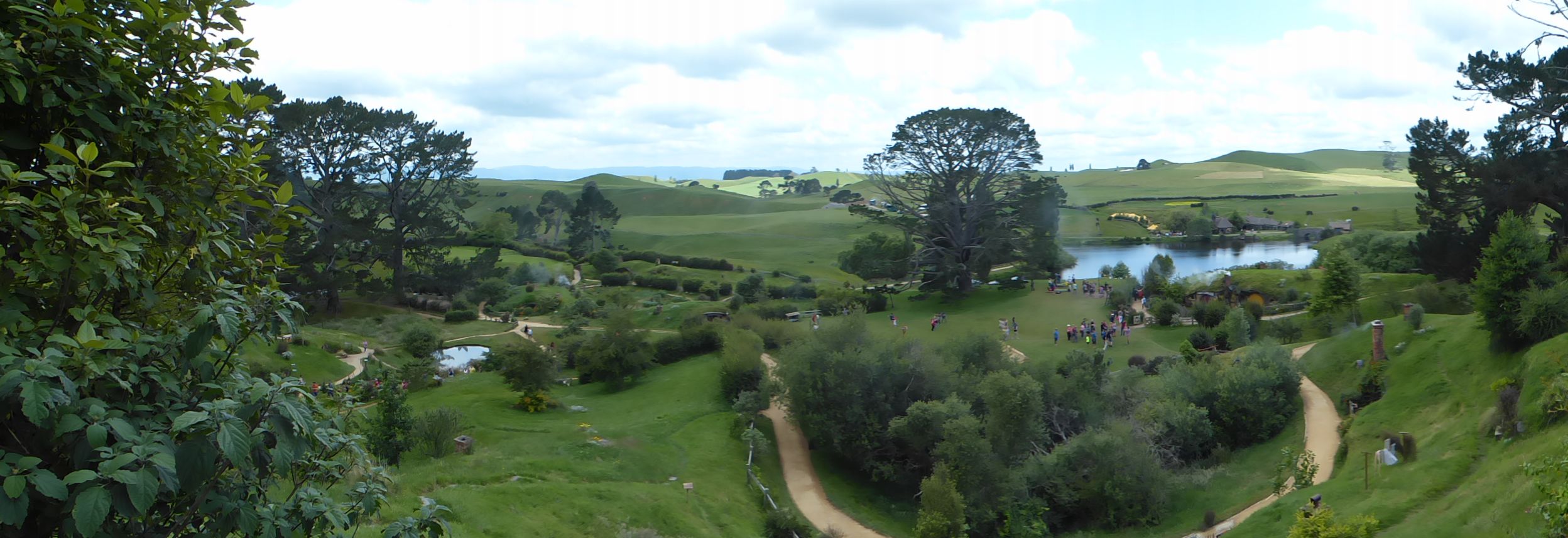
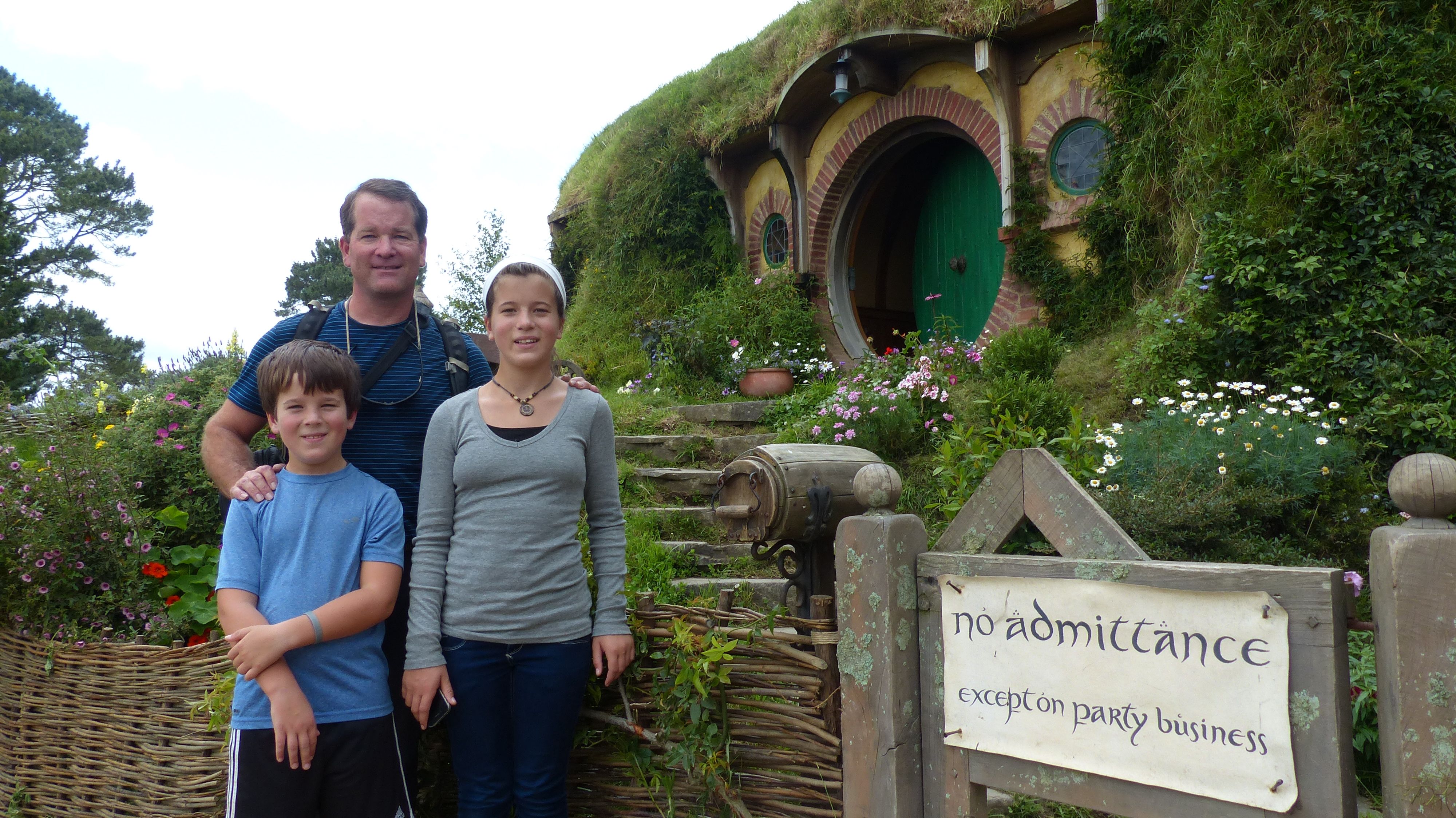
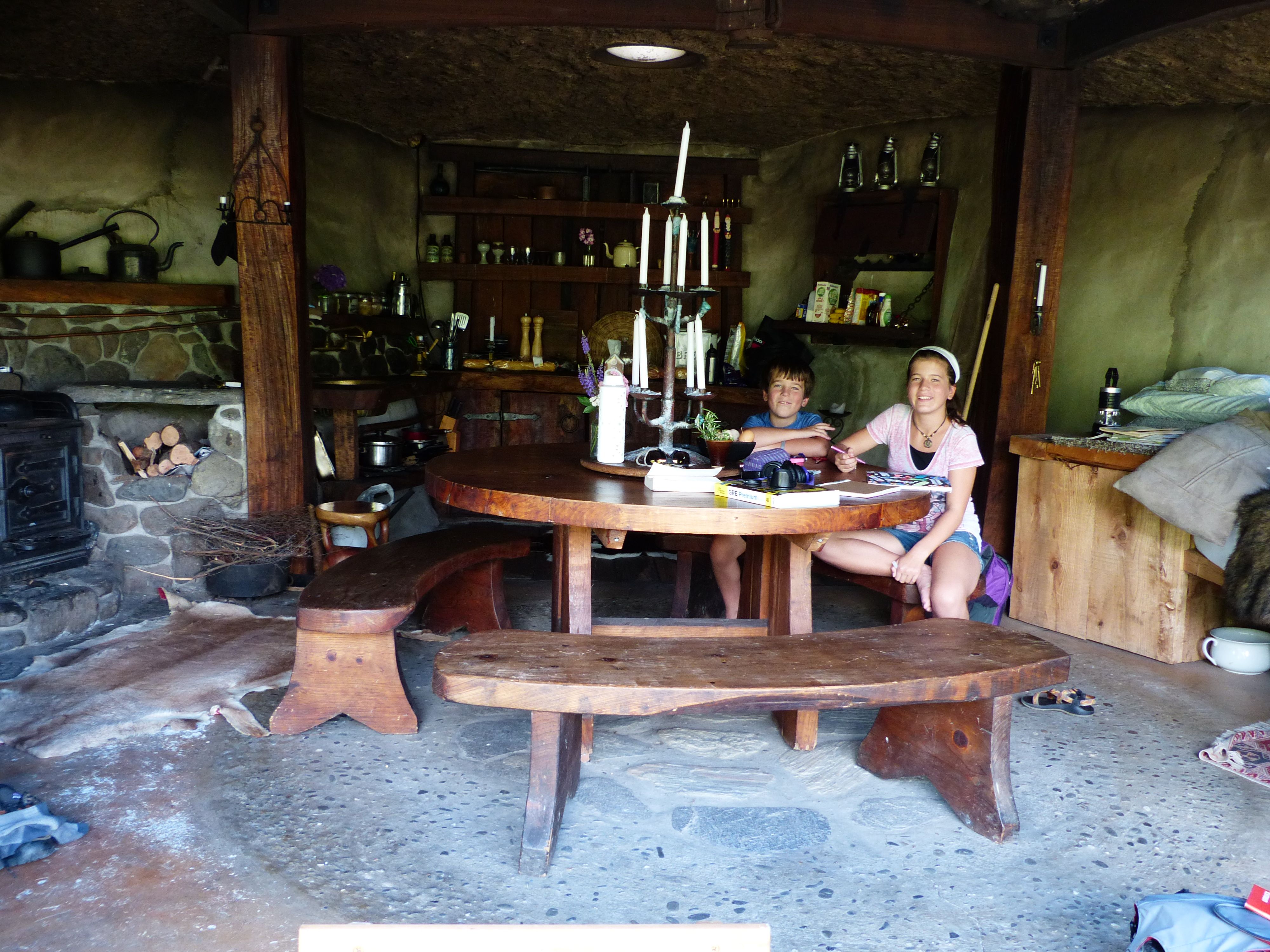


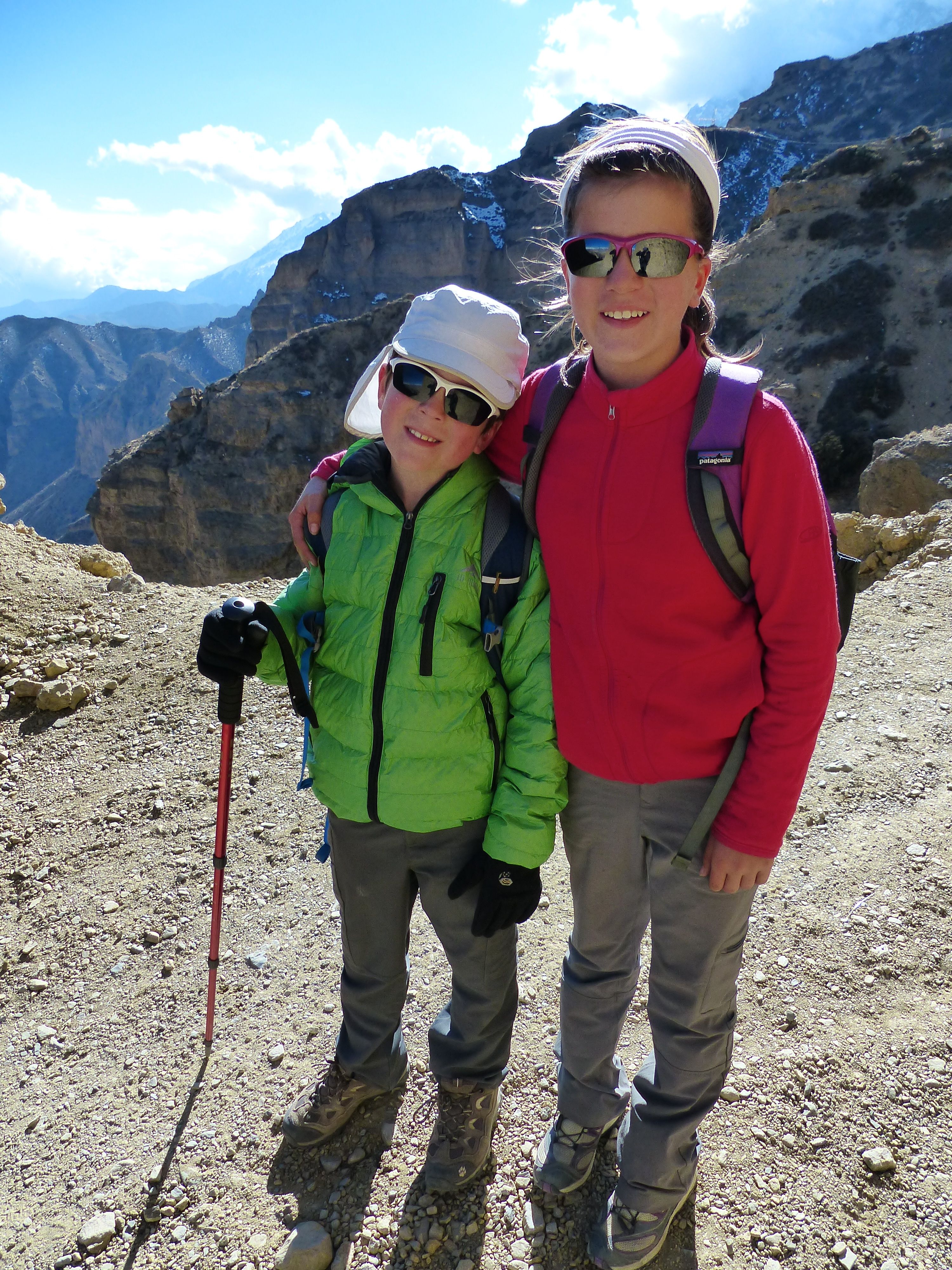

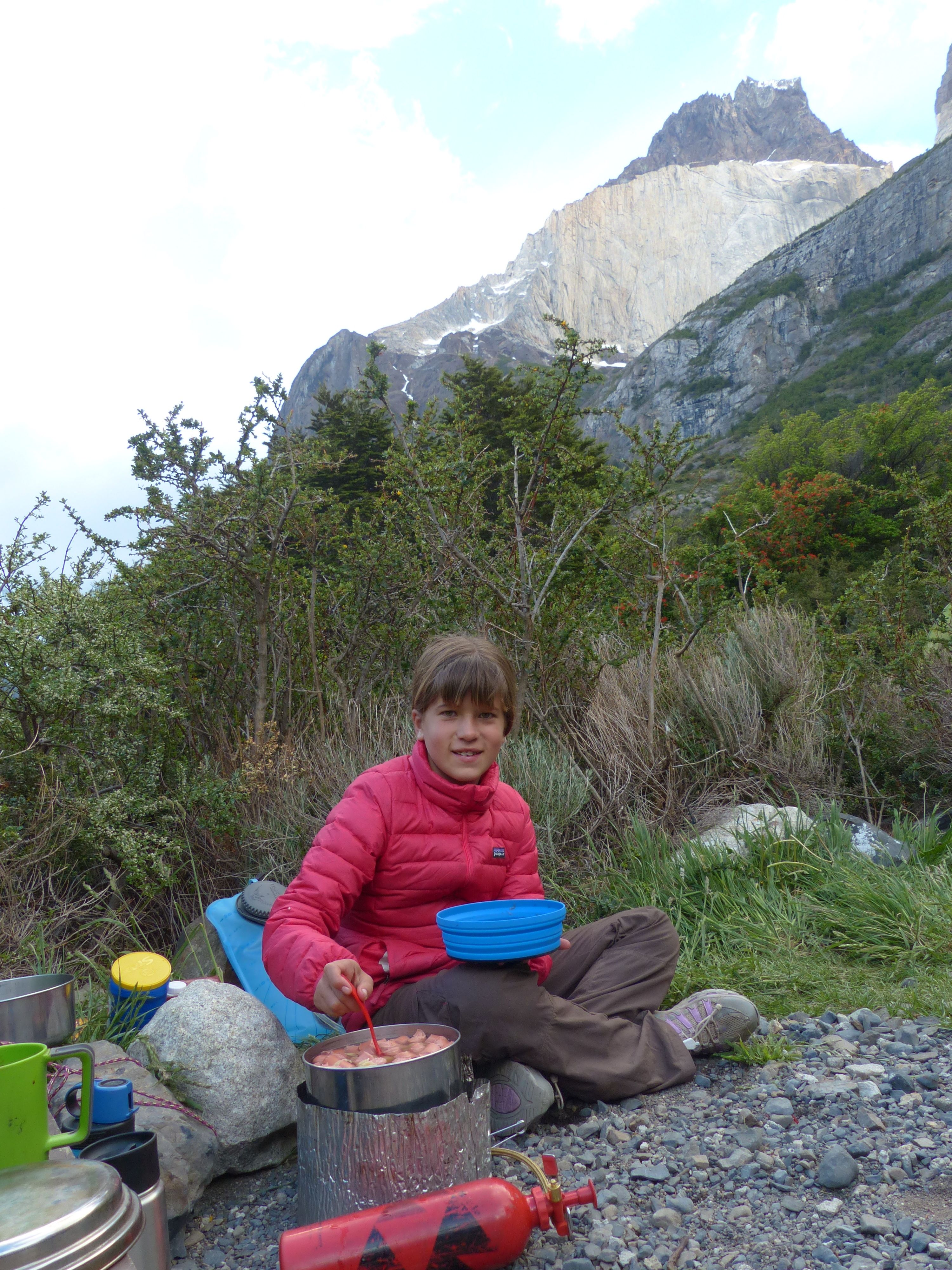
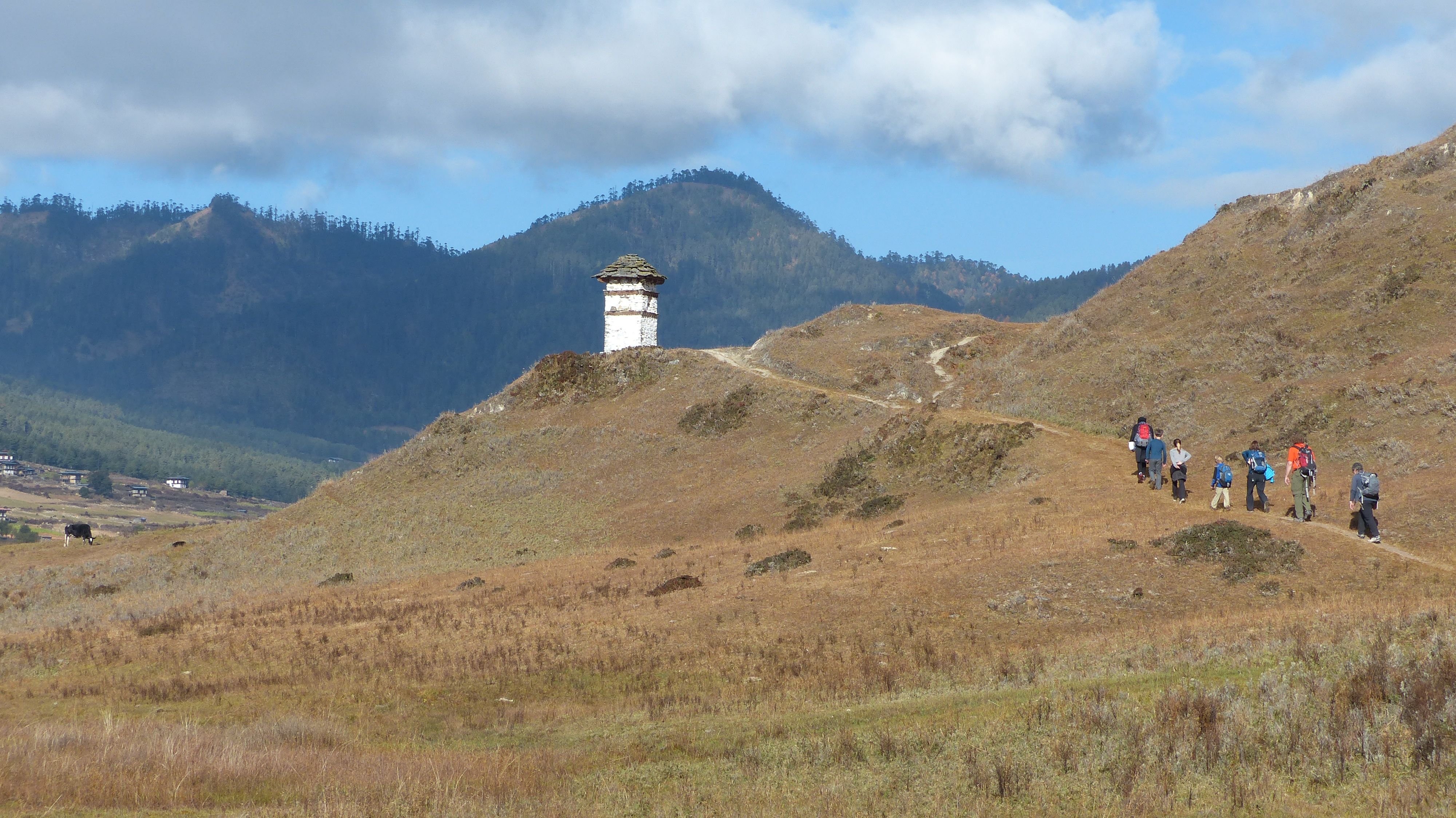
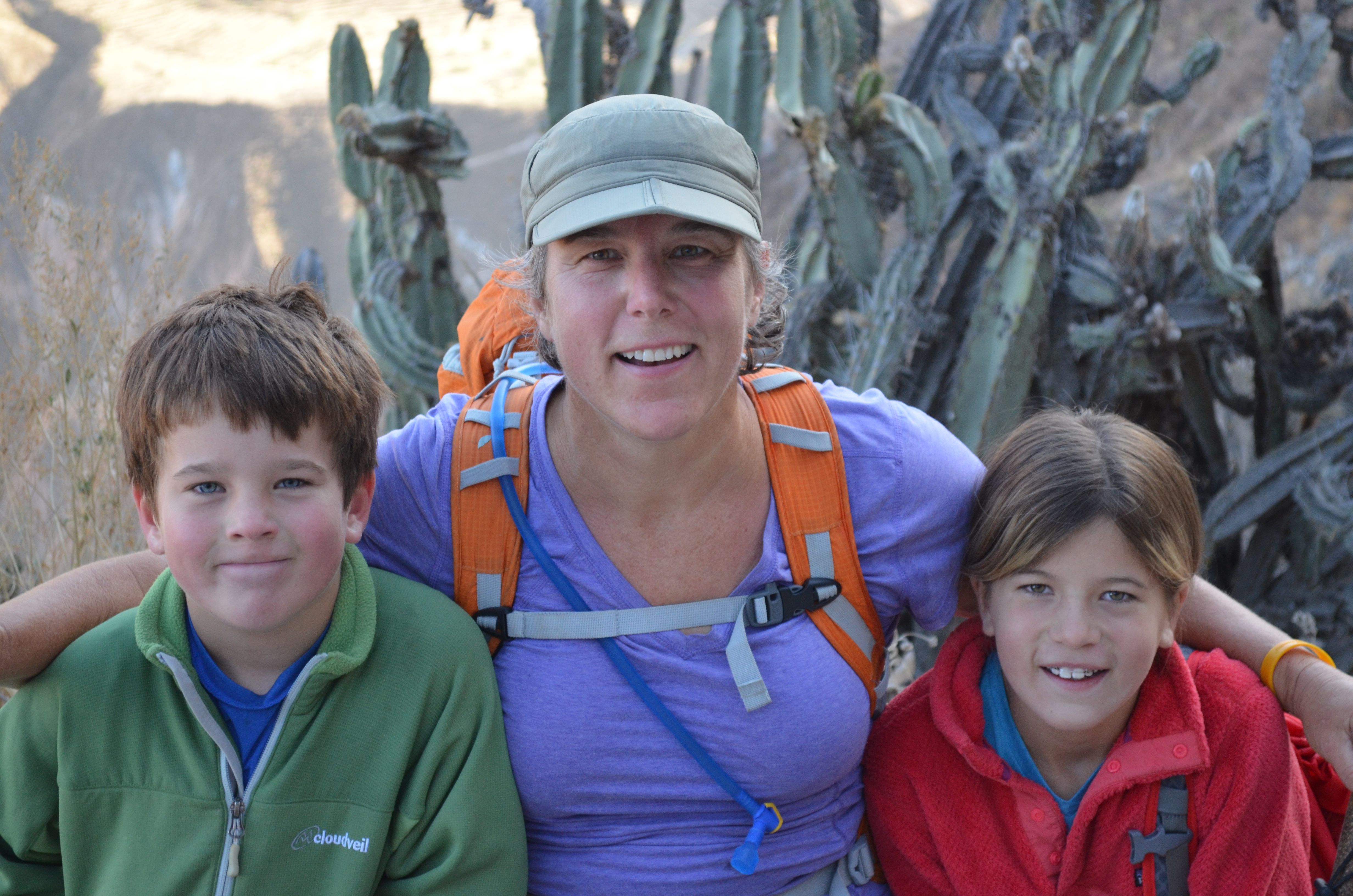
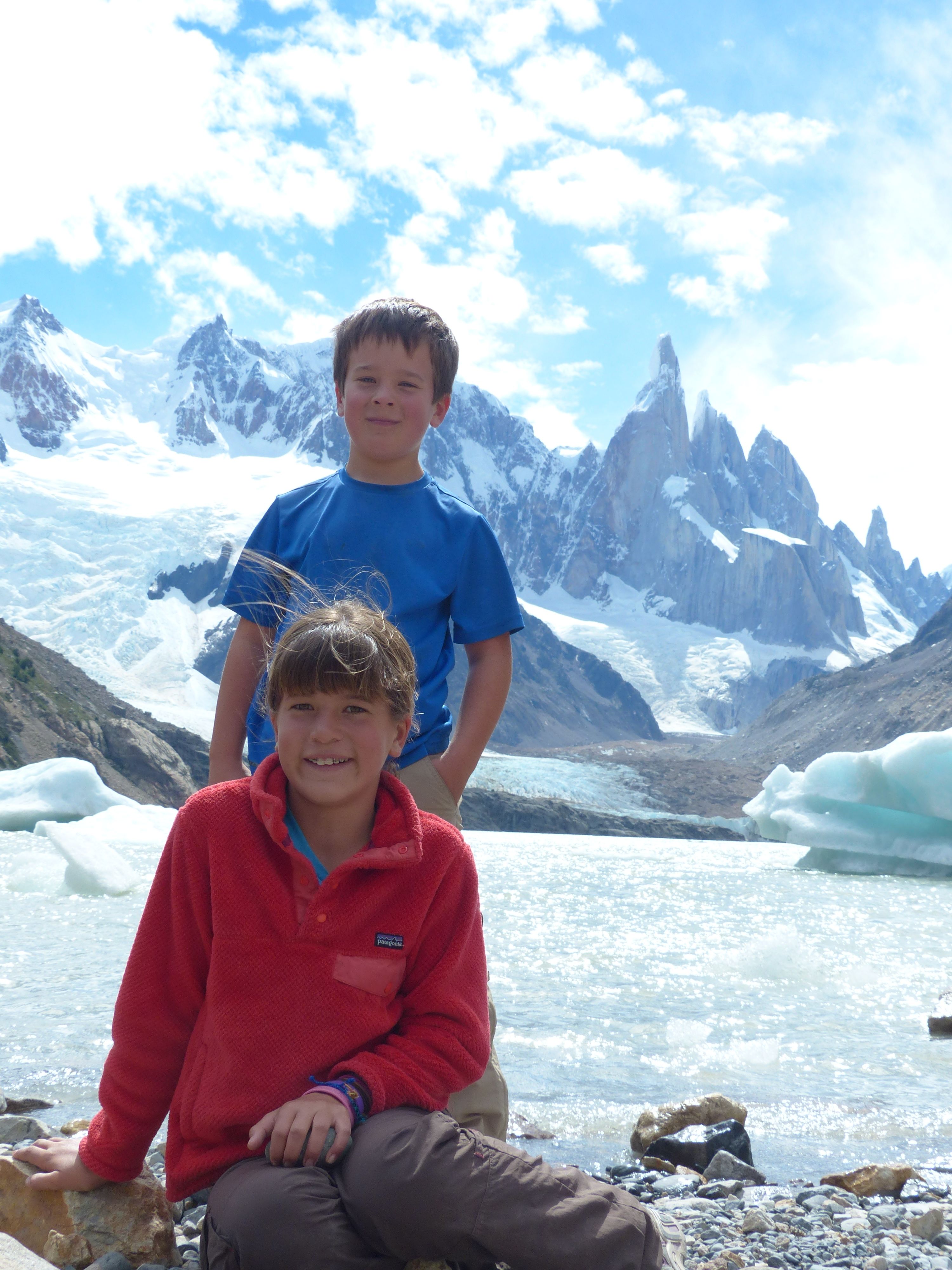
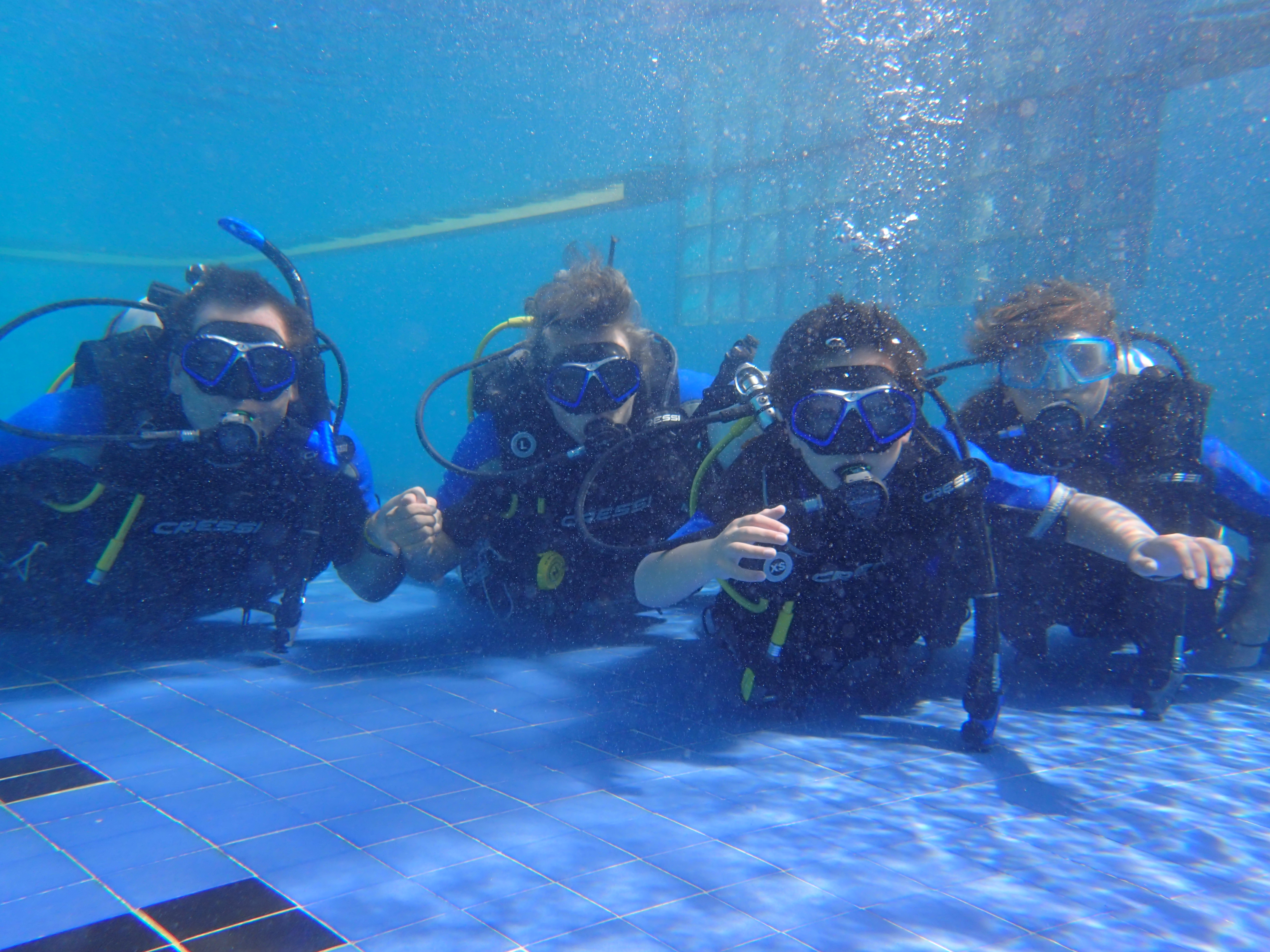


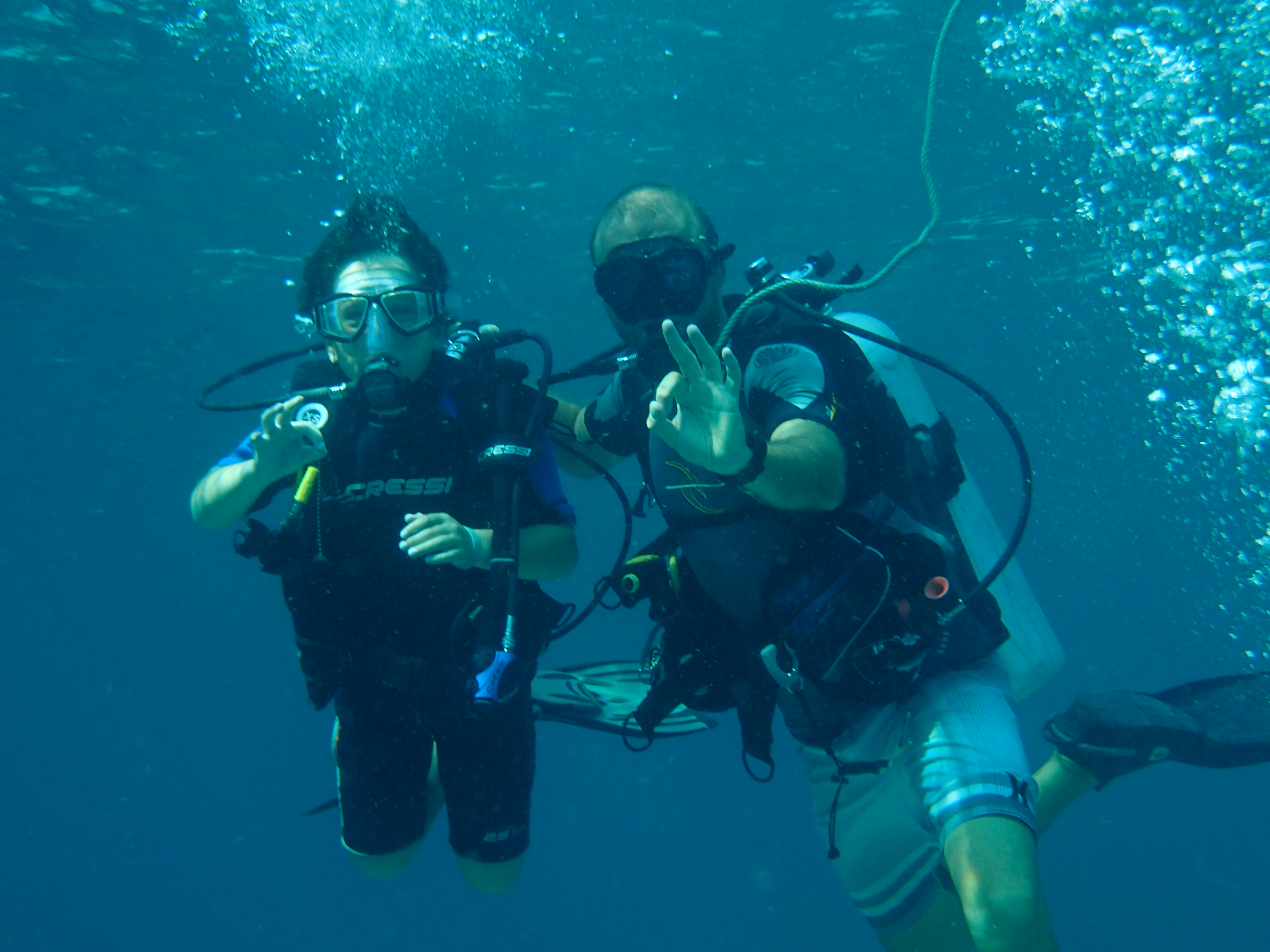


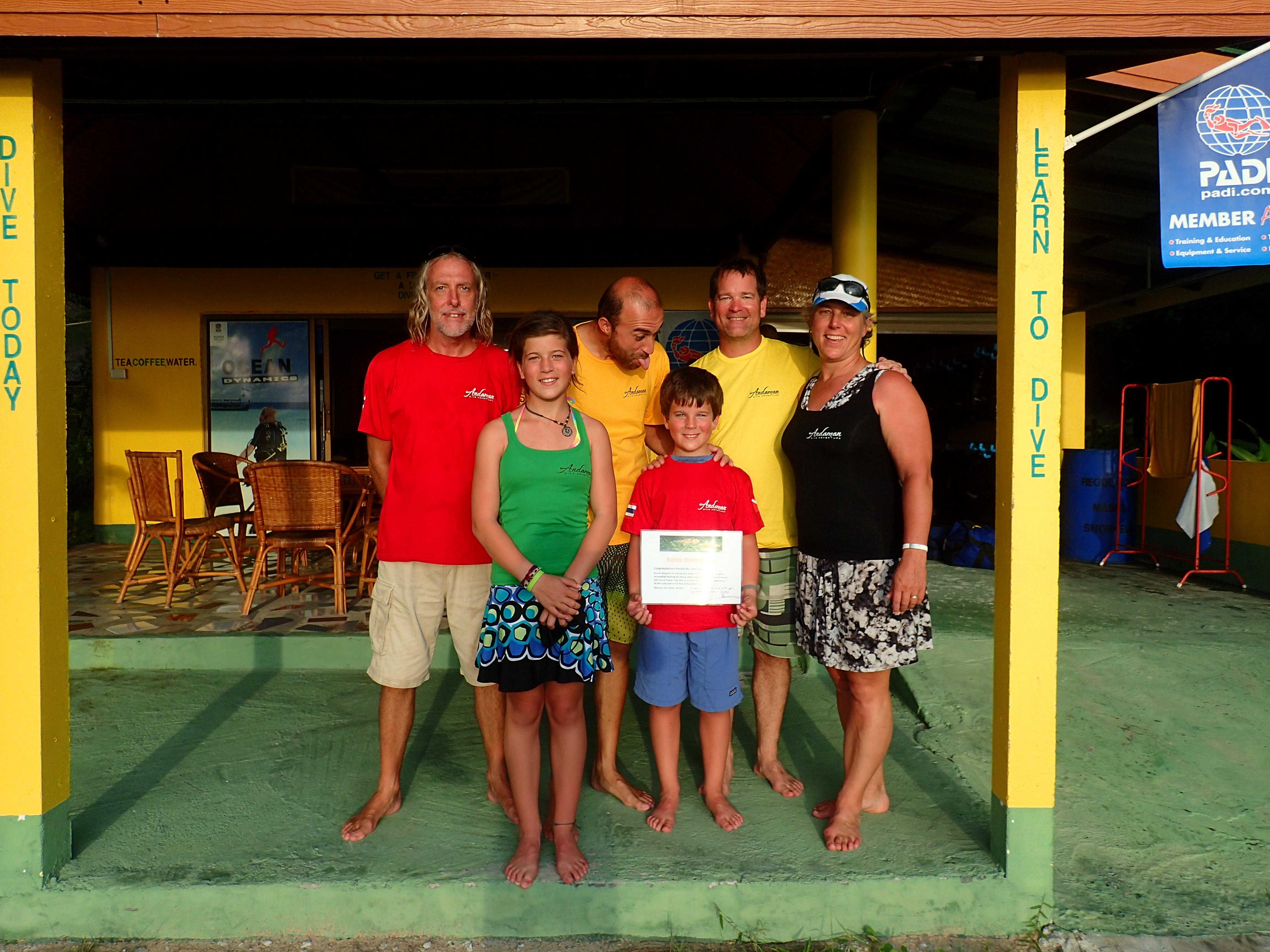

 The Shindells - Four to Go